


News
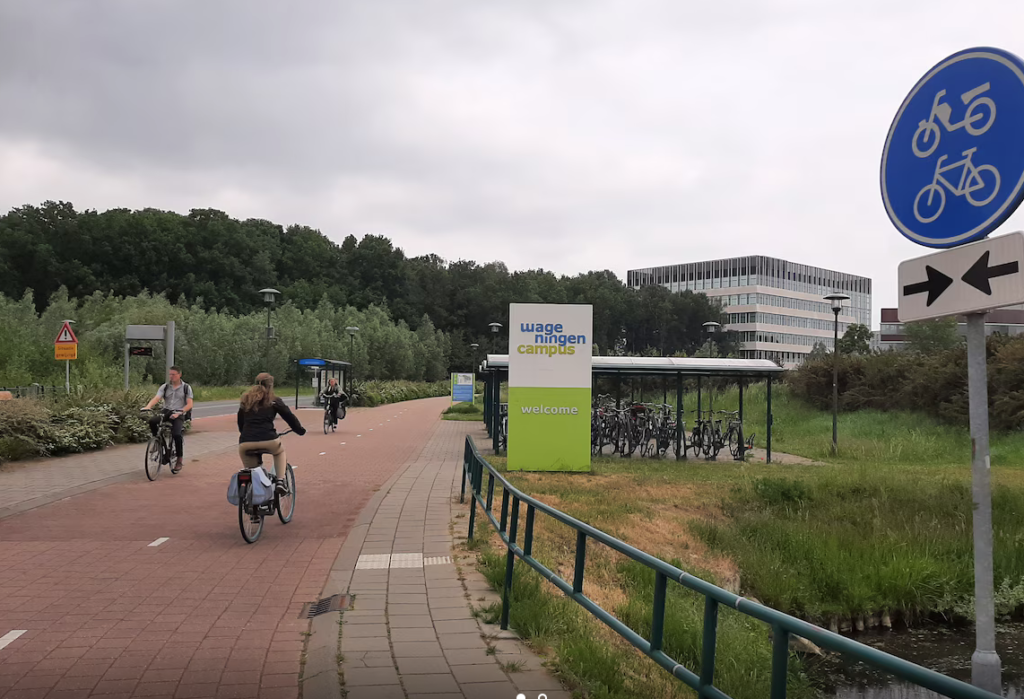
Wageningen University promised access road on west side of Wageningen in near future.
Good news for everyone who wants to reach Wageningen University by car.…
Lees meer +Going to daycare for the first time
You have registered your baby at our daycare center. We are delighted that you have confidence in us as a childcare organization and together we will do everything we can to ensure that your baby and you have a good time. In this brochure you can read what you can think about when your baby goes to the nursery for the first time. With this we hope to prepare you for a fun new period to come.
The intake
Babies usually start with us from 10 to 12 weeks old. Before the start date, your child will come to the nursery for a one morning introduction session. Preferably, you come to the intake together so you can meet your son or daughter’s mentor. Our pedagogical professional will ask you about your child, your family, the pregnancy and special circumstances. Personal attention is important to us; we would like to get to know each other. The intake will take about half an hour.
To the intake, please bring all necessary items for your baby. Below is a checklist of necessities.
✓ Bottle
✓ Enough formula or breast milk fort he day plus one extra feeding
✓ Sleepingbag with correct TOG Value (seasonal)
✓ Possibly a stuffed toy or pacifier
✓ Spare clothing
All products must have name tags. We unfortunately cannot accept glass jars and bottles.
Feeding must be measured per feeding (both bottle and breastfeeding) so that we do not have to dose. You will provide the number of ml of water per feeding to the mentor at intake and again if there are any changes.
We inform parents about the condition of the bedrooms so parents know if a winter or summer
sleeping bag is needed at daycare. Other food, diapers and wipes are included in the price. If your child is sensitive to a particular product please notify us and we will provide an appropriate solution.
You may bring your son or daughter to us in a washable diaper. However, we use disposable
diapers ourselves and give the washable diaper back to you at the end of the day.
During the intake we ask about allergies, special needs and vaccinations. We also ask you to be open and honest about your situation and how you and your child are doing. You can contact the mentor or other educational professionals with all your questions, including parenting questions. We mainly follow your rhythm from home, especially in the baby group.
Being able to drink from a bottle When your son or daughter starts with us, it is important that he or she can drink from a bottle. If you choose to breastfeed at our location you are more than welcome. Even then, in case you are really unable to attend, it is important that your baby can drink from a bottle. For tips or more information, click here.*
Sleeping in a crib
At our nursery, several babies often sleep in a bedroom around the same time. We always try to put the children to sleep in the bedroom so that they can fully relax. Exceptionally, a child may temporarily sleep in the group, but because of the stimuli in the group we try to avoid this. It is therefore important that your child is used to falling asleep in a bed, rather than in your arms or on your lap. Our pedagogical professionals lovingly cuddle and feed on your lap, but also need to have their hands free for the other children afterwards. For more information on sleeping in bed, look here.**
Skilled pedagogical professionals
Our pedagogical staff are specialist trained with a comprehensive course ‘Ruimte voor baby’s’,which is mandatory according to the IKK law. We believe it is important that staff members can empathize with the young child and that they are aware of everything a child experiences with us in a day. During this course, there is ample attention to the First 1000 days and we actively work with this on the work floor. This way we work on a nice, calm atmosphere in the group and try to avoid stress in children and colleagues. In this way we hope to continue the important first basis for a healthy future from the belly and your family with us. For more information about the First 1000 Days click here.
https://www.gezondegeneratie.nl/1e-1000-dagen/ (dutch site)
https://thousanddays.org/ (english site)
We hope this will help you get started at our daycare center. If you have not yet had a tour with us you can request one by clicking the button Request tour. We look forward to welcoming you to our nursery. If you have any questions please contact us via the contact page or call 0317 328
119.
*leaflet drinking from a bottle
**Learn to sleep in be
Pedagogical Policy

Pedagogical Policy
Daycare Prins Vleermuis Campus is located in Wageningen. The daycare Prins Vleermuis Campus is mostly
known as daycare Prins Vleermuis Wageningen.
The branch in Wageningen
Address:
Plantage 10
6708 WJ Wageningen
This branch has room for six daycare groups:
– two baby groups (0 to 2 year-old) each has space for thirteen babies.
Babymuisjes
Dwergmuisjes
– one toddler groups (1 to 3 year-old) each has space for sixteen toddlers.
Supermuisjes
– two preschooler groups (2 to 4 year-old) each has space for sixteen preschoolers.
Kaboutermuisjes (VVE group)
Reuzenmuisjes
There is also one additional room in which the two toddler groups can do activities.
In case there isn’t enough staff on hand all the groups will be merged together for the day.
The Babymuisjes has as a 2nd core group the Dwergmuisjes (0-2 years).
The Dwergmuisjes have as their 2nd main group the Supermuisjes (1-3 years)
The Supermuisjes has as 2nd root group the Reuzenmuisjes (2-4 years)
The Reuzenmuisjes has as 2nd root group the Kaboutermuisjes (2-4 years)
The Kaboutermuisjes has as 2nd stem group the Reuzenmuisjes (2-4 years)
Important exclusion is the children with the VVE indication will be kept in the special VVE group, the
Kaboutermuisjes.
Worker-child ratio (WCR)
Since January first 2009 the care of three babies of the age zero to one years-old is allowed by one
pedagogical employee. The toddlers ages one to two years-old can one pedagogical employee look after five
children on their own. And the preschooler group two to four years-old can one pedagogical employee look
after eight children on their own.
As soon as the allowed number of children for one employee is exceeded another employee will join the first
one. When there are multiple children of different age groups, the worker-child ratio will be revised tot the
standard of the proper guidelines.
When children reach an certain age, there will be a revision to see if the child can go to the higher age group.
This will be done at the hand of the development of the child and observations from the employees.
Pagina 5 Campus Pedagogical Policy, changes from 09/01/2025Pagina 6 Campus Pedagogical Policy, changes from 09/01/2025Four-eye principle
At day care (children 0-4 years old), it is a legal requirement to apply the four-eye principle. This is an
important part of limiting the risk of cross-border behaviour. The law requires that care be organized in such
a way that a pedagogical staff member, pedagogical staff member in training, trainee, volunteer or other
adult can only perform the work while being seen or heard by another adult. The purpose of this principle is
to reduce the risk of child abuse by preventing adults from being able to withdraw unheard or unseen with a
child for extended periods of time within a daycare or preschool. The day care at our location is organized so
that a pedagogical staff member, pedagogical staff member in training, intern or other adult can perform his
or her duties only while being seen or heard by another adult.
Regular faces criteria
A familiar pedagogical employee makes a child feel emotional secure. So when your child is at daycare at
least one of the present employees sees your child on a regular bases. Because this employee would know
how the child develops, what their needs are, what up sets them. For this reason the regular faces don’t get
switched around a lot.
Some guidelines:
– When 1 or 2 pedagogical employees are working the same group, by the rules of the worker-child ratio it
means that maximum two are regular faces per present baby. For toddlers and preschoolers this means they
have three regular faces per present child.
– When 3 or more pedagogical employees are working the same group, by the rules of the worker-child ratio
it means that maximum three are regular faces per present baby. For toddlers and preschoolers this means
they have four regular faces per present child.
Since the first of July 2023, childcare providers may temporarily employ a professional other than a regular
face. This is allowed if a regular face is ill, on leave, or on holiday. However, several conditions must be met.
The conditions:
– Deviation is only permitted in situations where a maximum of two or three regular faces are assigned
according to the regular faces criteria, not in situations where four regular faces may be assigned.
– There is no other regular face available that can be used to replace the absent regular face.
– A regular face is absent due to illness, holiday, or leave. They may not be absent for more than four
consecutive weeks. In that case, another regular face is appointed.
– The provider has written down in the pedagogical policy how another appointed professional can
guarantee the emotional safety and stability of the children.
From July 1, 2024, holders may employ a trainee professional as a permanent professional (permanent face). This
is only allowed if the trainee professional has completed the first year of training. When a trainee professional is
deployed as a permanent professional, the following rules apply:
– The holder ensures that it is written down how the trainee professional is supervised as a permanent
professional and how that supervision is applied in practice. The practice supervisor evaluates at least once a
Pagina 7 Campus Pedagogical Policy, changes from 09/01/2025month with the trainee professional how signals and individual needs of children are responded to. The trainee
professional is also coached by the pedagogical coach.
– The trainee professional, the training supervisor and the practical supervisor from the day care must agree in
writing on the agreements about the coaching.
Points of attention:
– On days when the trainee professional works in the tribal group, at least one qualified professional must also
work there. This also applies if the trainee professional is not a regular professional.
– A maximum of half of the staff at a children’s centre may consist of trainee professionals.
This is how the emotional safety and stability of the children is guaranteed when their usual
regular face isn’t available
Children at the Campus daycare often come multiple days a week. This means that the contract hours of the
pedagogical employees collectively are more than enough to provide almost always regular faces. Because
the size of the employee group, it’s easy to internally get a new regular face on the group that misses a
regular face.
Since a revision of the rules on July the first can interns be used as fixed faces. At the daycare are interns
always guided by a regular employee off the group they are assigned too. In case we have no internal
employees available to work, we have to turn to help from outside of the Campus location. This means a
substitute may come from one of the other two Prins Vleermuis locations. If the substitute is from another
Prins Vleermuis location have no worries they work with the same mission and vision. Even employees who
usually don’t work with the children but are behind a desk are certified pedagogical employees. They can
also be substituted on the groups that misses workers. This all makes it so that the children hardly ever have
to deal with strangers or non-certified employees at the groups.
Steps we take when a regular face isn’t available, in order:
1. We look if there are children on the brink of switching groups and let them go play at their future new
group to change the number of children at the group that misses a worker.
2. We try to see if a regular face off the group from another day can work.
3. We try to switch present colleagues around
4. We try if desk workers can work at the group that misses a worker.
5. We see if we can switch some children round to groups with workers that also are familiar with them.
6. We see if we can call a college from another location
7. We approach our regular substitute to work that day.
If none of the above mentioned steps work we have to close that group as we don’t use external
substitutes.
Pagina 8 Campus Pedagogical Policy, changes from 09/01/2025Vision and mission
Pedagogical main goal
The main pedagogical goal is that the children will ultimately develop into social, independent people with
self-confidence and a sense of responsibility, who recognize and use their own talents. This is achieved by
giving each child space for their individuality. And by creating situations within the daycare that ensure that
the children feel comfortable, safe, and secure.
Good contact with parents/guardians is important to ensure this pedagogical goal. The pedagogical staff will
have a guiding and stimulating role concerning the individual child, but also in the group process. So a
positive work attitude of employees is essential.
Daycare Prins Vleermuis offers care and development to all children entrusted to them. Every child is
entitled to stimulating support from a pedagogical employee. Personal contact between the pedagogical
employee, parents, and children is paramount. We achieve this by offering trust, safety, and security by
verbally transferring between parents and pedagogical employees.
Who is the smiling bat with a crown?
The daycare logo is a smiling bat with a crown. Every decision about the logo has been with mission and
vision of the daycare in mind. For example the open spread wings of the bat, represent the open invitation
for each child to develop their individuality. As to say spread your wings child and discover the world and
yourself, become who you are meant to be.
The crown is because every child deserves a crown to give them a feeling of being understood and taken
serious. Because at the daycare Prins Vleermuis we believe that every child needs to be listened too, to give
them a feeling of acceptance and to give them a positive self image.
A team of regular pedagogical employees ensures that they provides trust and security.
In addition, we also offer every child confidence and security by communicating with the children at eye
level, actively listening to the child’s needs, and responding to them with personal attention.
Opening time
Daycare Prins Vleermuis is open every Monday till Friday between 7.30 to 18.30. We offer on request and
staff availability the option to have early daycare from 7.00 am. Since 01-03-2019 Prins Vleermuis only offers
whole days as daycare options so no half-days or flexible daycare. Parents who currently use the half day
daycare option in their regular contracts are allowed to keep using the option for the remainder of their
contract period. A contract period usually runs till the child reaches the maximum age of four years-old. No
new contracts will have the half day daycare option.
The only exception to this is no half day policy is the before school education groups (VVE). A half day is from
7.30 to 13.00 or between 13.00 to 18.30. Before school education (VVE) is offered on Monday till Friday
from 8.00 to 13.00 or between 13.00 to 18.00.
Enrollment policy
Pagina 9 Campus Pedagogical Policy, changes from 09/01/2025⚫ It is possible to enroll your child during pregnancy. (It’s preferred because of waiting lists)
⚫ Siblings will get priority with placement
⚫ The registration date will only take effect once you have had a building tour, the registration form has
been completely filled in and the registration costs have been paid.
Introductions
When parents get a tour of the daycare, we assume they already read our website and agreed with our
pedagogical policy. At the next visit they will do an intake with one of the pedagogical employees of the
group their child will be place at. At the end of that conversation their child will stay for half a day to get
used to daycare and for the employees to get to know the child. For this intake conversation the pedagogical
employee will contact the parents, usually this happens a month before the registration date will take affect.
Getting accustomed at Prins Vleermuis
Like mentioned above a while before your child is officially enrolled at the daycare, an intake and getting
accustomed appointment will be made. The getting accustomed appointment will take place in the mornings
usually from 9.30 to 12.30. At the start of this accustom appointment we talk about some basic information
about the rhythm of the child, possible allergies, exceptions to the norm. We use a intake form as a guide
during this conversation that we will fill in together.
If the child shows signs of difficulty separation, the child will get extra attention in being comforted. It can be
useful to inform the daycare worker of your child’s favorite toys or type of toy, so it can be entertained with
something familiar. In extreme case a second accustom appointment can be recommended by the
pedagogical employee. Or other solutions can be discussed between parent and pedagogical employee.
For every individual child will be observed before they will be placed in the next age group. This has to do
with the child’s needs and placement options. The switch between baby and toddler group usually takes
place between ages one and two years-old. The switch between toddler and preschooler group usually takes
place between ages two and three years-old.
Before the child goes to the next group it will again have accustom appointments, only this time during
daycare hours, so with a pedagogical employee. Usually we slowly build the accustom periods, first maybe
fifteen minutes, then an hour, maybe a few hours to eventual a day. The amount depends on how well the
child takes to the new group. With this moving to a new group the parents also will be contacted by the
child’s new regular pedagogical employee, this will be added to the child’s daycare information.
The general quality rules of the daycare act and the underlying decisions and arrangements that belong to
the accustom period:
– Getting used to without a paper daycare agreement isn’t possible
– A new child counts on the worker-child ratio off that daycare group.
– A new child that goes to a different group to get accustomed they don’t count on the worker-child ratio
Pagina 10 Campus Pedagogical Policy, changes from 09/01/2025– The maximum allowed number of children of one group can’t be crossed when a new child comes to get
accustomed to the daycare.
Additional partial daycare
If you, as a parent/guardian, want to use the extra half-day option, this is possible, provided there is room in
the group your child belongs to. You can request an extra half day or extra half days via KidsKonnect. Parents
can see in the KidsKonnect parent portal whether the application has been approved or not. The additional
half-days will be invoiced extra.
Pagina 11 Campus Pedagogical Policy, changes from 09/01/2025Pedagogical principals
• Offering professional and high-quality daycare, through qualified employees, in specially equipped
rooms, when parents participate in other community activities.
• The daycare offers an extension of the child’s home life.
• It allows children to become acquainted with other ways of being raised and development.
• The child learns to interact with a larger group of children spontaneously, comparable to a large
family. From an early age, the child develops social skills to live and work in a larger group.
Daycare Prins Vleermuis tries to be an extension of the child’s home life. We strive for children to feel safe
and secure so that every child can be themselves and develop in their own way. Every child has its own
development potential. The extent and pace at which a child develops depends on what the environment
offers. The pedagogical employees’ approach aims to further develop what a child can already do and what
the child likes. A positive approach is chosen to further grow the child’s self-confidence. If the pedagogical
employee notices that a child is developing noticeably different, the parents will be contacted.
Emotional safety
Emotional safety is needed to develop. At Prins Vleermuis we offer this in different manners:
• We work with a team of regular pedagogical employees.
• We make sure to greet every child by name when they enter the group.
• Every child has a designated space for their personal belongings.
• Every room has a pedagogical employee present that the children can to go to for guidance.
• The pedagogical employees are alert that no children feel excluded during group activities. They are
trained to constantly observe the children.
• Till the age of two-years-old the children get observed every 5 months. After 2 years, observations
take place every six months. These observations form the basics for a parent meeting to which
parents are invited once a year. If necessary, this can ofcourse be done more often in consultation.
• During teammeetings and in the daily reports, the well-being of the children is also documented and
looked at carefully.
• A regular schedule offers the children stability, peace, and security. Daily schedule cards are used to
visualize the schedule. These daily schedule cards are hung up so it is clear to see what the day will
look like for both the children and the parents.
To ensure that a child recognizes and accepts emotions of themselves and others, the pedagogical employee
will try to put words to the children’s feelings as much as possible. Naming these feelings takes place in a
one-on-one conversation or through play
Example:
The pedagogical employees are spread throughout the room, this way the children can always
see them or make eye-contact during play. This gives the children feelings of trust and safety.
Pagina 12 Campus Pedagogical Policy, changes from 09/01/2025Physical competencies
Children between the ages 0 to 4 go through some pretty big developments. We make a distinction here
between gross and fine motor skills. Gross motor skills are stimulated by offering game opportunities that
offer a challenge, adapted to the age of the children. We stimulate fine motor skills with smaller
movements. Coordination between hands and eyes requires fine motor skills.
Example:
For babies fine motor skills can be as simple as lifting something and putting it in their mouth. For toddlers
and preschoolers it can be trained through finger painting or making their own sandwich.
The pedagogical employees are tasked with observing, and signaling the child’s competencies. The
employees stimulate and guide the children in their motor skills. When the children are older, we encourage
this by making puzzles, drawings, and doing crafts. To stimulate babies’ fine motor skills, toys are offered
such as rattles, rustle books, or other attributes they can grasp. Daily health care also contributes to the
development of fine motor skills, for example: transferring toys, putting on a coat, or drinking from a bottle
to spout, to a cup.
Social competencies
At the different groups of Prins Vleermuis we work on expanding the children’s social skills. At Prins
Vleermuis we are of the opinion that the pedagogical staff needs to stimulate the children to increase their
social skills. Social skills like playing together and dissolving conflicts. This gets done because the pedagogical
employees to communicate openly and clear with the children. Open en clear communication means;
⚫ Prevent conflicts
⚫ Make the children solve their own conflicts or together with the pedagogical employee
⚫ Stimulate children to communicate among them.
⚫ Make the children aware of the emotions of the other children.
Example:
One of the preschoolers takes a doll from another child. That child starts to cry. When the crying child doesn’t
take action, the pedagogical employee goes to the crying child and ask the child with the doll to come too. To
the crying child you something like this is said: ‘’I see you are upset, can you tell me what happened?’’ To the
other child something like this is said: ‘’Do you see that (name crying child) is sad, do you know why that is?’’
The pedagogical employee makes sure that the children are aware of each others feelings and how their
behavior effects others.
Sensitive and responsive way of interacting
A child needs others to feel comfortable and develop properly. They need attention, warmth, and emotional
support. Every child shows this in their way. Therefore you must be sensitive (‘sensitive’) to the signals the
child sends, by looking closely at the child and trying to understand what he or she means. You must
respond adequately (‘responsive’) by reacting correctly to the child’s signals. It’s of importance that the
emotions and feelings of the children are acknowledged by the pedagogical employee. This shows that you
are involved in what the child does, what they feel and experience, that you understand this and that you
Pagina 13 Campus Pedagogical Policy, changes from 09/01/2025support the child. This does not always mean that the child gets what they want. You can’t always meet their
wishes, but you can show that you understand their feelings.
Example:
In the event of an argument between two children, you can show that you are there for both and you can
help the children to express their feelings to each other and to find a solution to the conflict.
If you do this consistently, the child will learn that it can depend on you, that you find the child worthwhile
and that you have confidence in the child. This gives the child a feeling of security, you form a safe haven for
the child. This will give the child confidence in the environment and in itself, it dares to explore the
environment and try new things. A child will therefore be able to practice new skills and further develop
himself. A child that sensitive and responsive reactions experiences form its caregivers will develop resilient.
A child that is resilient, has flexibility and perseverance to solve problems and adjust to new or different
situations. Because of this the child can handle stress better. At the same time the child will develop
empathy. This will make the child try to understand and help others.
Norms and values
At Prins Vleermuis we expect our pedagogical employees to be aware that they have to set a good example
for the children. Children copy behavior, that’s why its so important to have clear rules about the norms and
values that Prins Vleermuis uses.
Norms are guidelines to actions
Values indicate what desirable (behavior)
At Prins Vleermuis we believe its part of our job to teach the children basic norms and values. This might be
things like: uphold the rules and keep promises, respect others, be polite, share, play together, don’t hurt
others.
In order to function and partake in society the children learn to deal with rules, norms and values: so we
want to internalize the culture of that society. Since birth are children socialized in their families. Through
explanations, instructions, and demonstrating, children learn the rules of conduct off their family, but also
the rules, norms and values that their parents consider important for their child to function well outside the
family.
Socializing also takes place within Prins Vleermuis. Children learn the rules of the group, but also general
values and norms. We believe it is important that the socialization at daycare is tailored to the development
of the children, but also that socialization in the group is tailored to the people within the family of that
child.
Exchange off van norms and values
The exchange of norms and values is a constant, it happens on a group level (exchange between pedagogical
employee, the group and the children among peers ) as wel as on an individual level (exchange between
pedagogical employee and child). These exchanges are both verbal and none-verbal.
Examples:
Pagina 14 Campus Pedagogical Policy, changes from 09/01/2025Using expressions like ‘’wash your hands after using the bathroom’’ or compliment a child by simply raising
your thumb.
When the children don’t follow certain rules, norms or values, a warning will follow with an explanation as
to why those rules, norms and values exist. Children are supported in making the norms and values of the
groups they play at their own.
Cognitive development
With cognitive development we mean the development that has to do with language and thinking
skills. Language development also stimulates thinking skills. This enables the child to recognize and
organize information, gaining insight into themself and the surrounding world.
To stimulate cognitive development the so-called responsive method is used when approaching
the children. This means that pedagogical employees will identify a child’s behavior, after which an
action and/or a conversation can take place.
Examples:
1) The children are sitting in the room and screaming loudly. The pedagogical employee will then tell them
what they are doing (naming behavior) and clearly tell them that screaming is not allowed inside. The
pedagogical employee will also explain that screaming is not allowed, because then we can no longer
understand each other and that’s why we agreed not to scream inside.
2) A child knocks over their cup of orange juice. The pedagogical worker sees this and tells the child what
they have done and asks them to go to the kitchen to get a cloth. The child gets a cloth and together they
clean up the mess.
Its of great importance that the pedagogical employee speaks clearly and without dialect to stimulate the
language development of the children. During group conversations an employee will make sure that
speaking happens in turns. By monitoring the speaking turns you as an employee can challenge the children
to get a real conversation going with children listening and responding to what the others say.
The pedagogical employee makes sure to speak to the child at an appropriate closeness and kneels down to
the child’s eye level so they always speak face to face. The pedagogical employee is also able to think in the
child’s world of experience. You can do this by playing together with the child with the child as leader during
play but also when you comfort a child its important to think about how a child experiences the world.
The cognitive development also gets stimulated by singing together, reading, playing riddle games and
regularly solve problems together.
Example:
If a child gets into a conflict with another child, the pedagogical employee guides the children towards
solving the conflict among themselves. The pedagogical employee will only supervise and in case its
necessary will get involved. This involvement is something like separating the children so they can think
about what happened, how it made them feel and how they want to solve it. Then with the guidance of the
pedagogical employee will the children talk it over.
Pagina 15 Campus Pedagogical Policy, changes from 09/01/2025Creative development
To get a fully developed child, its also important to stimulate their creative development. You do
this by giving them autonomy over the activities they want to participate in. But if they always
say no they needs some stimulation just to try once or twice to participate.
When the child participates they have the freedom to do the activity how they want to, provided
that the other children aren’t disturbed by their behavior. The creativity to make the activity or
assignment their own should be positively reinforced by the pedagogical employee. The crafts
and assignments the children make will be displayed on the group rooms as much as possible.
Crafts include also things that are harder to display like playing with sand, dancing and face paint.
Example:
When one part of the group is playing, another part could be learning a made up dance routine
Identity development
The pedagogical employee respects the sense of self (cultural background, family situations and
character) from every individual child, without losing interests of the group as a whole. Every child
gets the opportunity to tell their stories and to chose what they want to play. By bringing a
competitive element into the activities you will stimulate the children on different levels. Like make
them learn from one another, learn their own weaknesses and strengths, which you as pedagogical
employee can approach and stimulate. Beside individual attention within the group the pedagogical
employee also pays attention to make the children aware of the group they are a part off. This gets
done by make the children share, wait for one another, make them aware off who is the youngest or
who the oldest his, things like that.
Example:
Waiting for one another: when the group goes on an outing, they make a line while holding on to the
evacuation chain. There is a pedagogical employee at the front and at the back of the chain. The line-
up is made in the hallway and the pedagogical employee and children wait until everybody is ready
and has a hold on the chain before they all walk outside
Self-sustainability
When children get older (four till twelve years-old) they get the urge to move more freely and with less
supervision. This will be in all environments the child come; school, at home, in their neighbourhood but also
at daycare and BSO (before and after school daycare). Fitting with their age and development requirements
the child will be stimulated to be more independent and self-reliant. By stimulation the self-reliants, the
children get more trust but also respect for themselves and others. Self-reliants with children younger than
four gets stimulated by making them relay messages to the group, solve their own conflicts but also by
making them do tasks like clean up after themselves and put on their own shoes and coat.
When children are at the oldest group of the BSO (think ten to twelve) the get more responsibility and
independence. Like they are allowed to walk to and from school by themselves or they are allowed to play
outside the borders of the daycare at nearby parks or sport areas.
Pagina 16 Campus Pedagogical Policy, changes from 09/01/2025Example:
During lunch children get stimulated to make their own sandwiches. When they made their own sandwich
children get complimented on a job well done. We also stimulate the older children to help the younger once
in case its wanted or needed. (Unwanted help is always wrong, asks first if help is needed).
Child participation
At Prins Vleermuis daycare we are of opinion that its important for children to feel comfortable and that
they allowed to develop at their own pace. To make this a reality its important to realize that children of all
ages have their own idea’s and opinions. That’s why at Prins Vleermuis we find it important to hear those
idea’s and opinions. Children are allowed to speak their mind about certain topics or are asked about their
opinion about activities and trips. It is the job of the pedagogical employee to listen to those opinions and
ideas. And to incorporate those opinions and ideas in future activities, crafts and assignments.
Pagina 17 Campus Pedagogical Policy, changes from 09/01/2025Work method
• Daycare Prins Vleermuis is a relative small organization with three locations. The children will get cared
for in an age appropriate living room similar to one in a one-family home. This is done on purpose, to
make the children feel at home and comfortable.
• Daycare Prins Vleermuis uses a vision that resembles raising a child in a home-like-setting. That’s why
the daycare rooms are equipped to give off a warm and cozy feel.
• The parents that chose daycare Prins Vleermuis are choosing for a form of daycare that is small with a
pedagogical policy that resembles their parenting style.
• The older children can pick their own play and can play with others their age. The children are free to
asks to play board games or do group activities with the pedagogical employees. With the younger
children (babies) more age appropriate activities are done like, sing, read books or make music.
• Sense of self in every child gets stimulated by the pedagogical employee. Children will get challenged
and stimulated through new activities, game material, crafts and music. When the children get bored its
the job of the pedagogical employee to stimulated the child maybe by reading to them, cuddle or just
take a moment of rest together.
• The pedagogical employee approaches the child with age appropriate material, games and
communication. The age and development stadia of the every child is therefor monitored carefully.
• The pedagogical employee guides the children in the mutual interaction and sets boundaries. This is to
prevent the children from hurting each other, destroy toys or ruin play. Its important to guide the
mutual interaction so the children learn to play together, make contact and learn from one another.
• The rules that are used are their to protect the warm and cosy setting and to offer the children structure
to grow and learn in.
• Autonomy is greatly stimulated especially when the pedagogical employee already know that the child
can do an activity all on their own with supervision ofcourse. Think off things like go to the toilet, make
their own sandwiches, clean up after themselves.
• Playing outside: if the opportunity is there we will take the children outside. This can be in the play area
outside the daycare but also outside the daycare’s territory. This means that we can take the children for
walks to nearby areas or go in the vehicles the daycare has available to go a bit farther away. Going
outside as much as possible is of great importance to us at Prins Vleermuis, ofcourse we will always take
the weather into consideration before deciding to go out.
• Young learned is done old! This is a dutch saying we use to lean our pre-schoolers playfully to be more
environmentally friendly.
Pagina 18 Campus Pedagogical Policy, changes from 09/01/2025Daycare day schedule
Day opening schedule
In the morning it can happen that two groups start mixed together. When it gets too busy (determined on
the pedagogical employee judgement) the groups go to their own rooms.
When entering the group parents and children will always be welcomed by a pedagogical employee. During
this drop off moment parent and pedagogical employee will exchange some information about the child, did
it sleep well, how was their weekend, did the child have breakfast yet. If it’s a baby its useful to tell when the
last bottle was fed and when the next should be. When the child experiences something noteworthy the
pedagogical can use this information when interacting with the child.
The times the child is being dropped off and picked up are noted because of the three-hour ruling.
Those attendance are done to know which children are present, in case of fire safety.
When the child arrives the pedagogical employee will tell the child what the day is going to look like and
after which activity they are being picked up again. This is especially important for the children who have
trouble separating from their parents.
The preschooler groups have pictures with the daily activities, hanging somewhere on the wall of the group.
So they can always look at which activities are done and which are going to happen. It also gives them a
sense of time. Parents and pedagogical employees can also use the daily activity pictures to talk about how
the day went and if anything important happened during the pickup moments. In between the planned
activities their is always time for free play and discovering new things.
Babies
When babies are dropped off at the daycare we try if possible to cuddle with them of keep them in our lap.
But when many babies are dropped off at the same time the baby is placed in the play pin, a rocking chair or
put on the floor on a rug with some toys. Babies till one year old are bottle fed and get pureed food. At the
daycare we try to keep the baby on the same schedule as it has at home. So sleep times, feedings and
playtime rhythm is documented carefully.
Toddlers
When the toddlers are dropped off and welcomed, they will be cuddled if possible. Otherwise they get put
on the floor or at the table to play with some toys provided for them. The toddlers are also free to pick their
own toys.
Pre-schoolers
When the pre-schoolers get dropped off and welcomed, they have some time to tell their stories or asks
questions. Then they are free to go play with the many toys they are free to chose.
Pagina 19 Campus Pedagogical Policy, changes from 09/01/2025Day schedule toddlers and pre-schoolers
At 9.30
Free play time is over and everything is put away in its place again. The children will come sit at the table or
if needed will be placed in high chairs. Together they say good morning and welcome to everybody. After
some song and stories, fruit and water is distributed among the children. After this food moment the
children can go and play again
At 11.30
water.
Play time is over and all the toys are put away again. Then its lunchtime so we eat bread and drink milk or
At 12.30
After the lunch the children go to sleep or play quietly. Midday always starts with creating a peaceful
environment in which the children can have some rest. Because its important that the children also learn
that rest is a part of the daily schedule. The children who don’t go to sleep do quiet activities like puzzle or
read a book.
Between 14.00 and 15.00
Sleep and quiet play time is over. And the children will be allowed to play around again.
At 15.30
Toys are being put away again and the children will come sit at the table. Its time to eat some vegetables,
drink some water and sometimes they also eat some breadsticks. During this time the children also get read
a story and sing some songs.
At 17.00
Children can get picked up from now on. So the pedagogical employees go over the day with the parents.
When parents have more pressing questions or need more time to talk their is always room to make a
scheduled appointment with the necessary parties.
Sometimes at 17.30 the groups will be merged together again to end the day as one group.
Playing indoors
When the children play indoors they play in their own groups. There is always a pedagogical employee
present. We offer the children challenging games to develop their skills or we play family board games. We
also do other activities like arts and crafts and we let the children free in their own play. Also they read, get
read or get told a story by the pedagogical employees. The children tell us how, when where and with who
they wanna play. We try to listen to the children when they tell us their preference.
Playing outdoors
We try to have outdoor play session at least once a day. Outside we have a space where they can move
around, make noise and explore the world. By playing outside the children will get to run, cycle, climb or
play in the sand or just chill in the fresh air. The children learn also new experiences through playing outside,
like be more independent, learn more about their bodies capabilities and more social skills.
Pagina 20 Campus Pedagogical Policy, changes from 09/01/2025Beside playing outside on the daycare playground we also go places with the children. Also the babies and
toddles can go outside in strollers. Place we go to are like the woods, playgrounds in the area, petting zoo or
sometimes we even take the children grocery shopping. At daycare Prins Vleermuis we give a lot of attention
to playing outside so children can fall or get dirty. So we asks of the parents to dress the children in clothes
that can get dirty and are weather appropriate. Also put enough spare clothes in the children their bags.
Pagina 21 Campus Pedagogical Policy, changes from 09/01/2025Core groups and mentor ship
Core groups
Every child at daycare Prins Vleermuis gets a core group appointed to them. This means that this is the group
where they will spent most of their time. This core group is where the children will spend most of their time
with the same pedagogical employees. Children only leave their core group when that group is doing
activities that can’t be done in this room. Think of activities like playing outdoors, going for walks, large arts
activities or specified holiday activities. Even though the activity won’t be done in the core group space the
activity will be done with the children who are placed in the same core group. While playing outside, the
other groups can also be outside and the children walk all over the place. Clear rules between the
pedagogical staff ensure that this runs smoothly.
In addition, children may be cared for in a different group and group room. This may be when children come
on a day beyond their scheduled daycare days and there is no room in their core group. It is also possible
that their core group is not open every day. If a child is scheduled on a day their core group is closed, they
will be cared for in another group. This is done in consultation with parents via a consent form.
Mentor ship
Every child gets a fixed mentor appointed to them. This mentor works on the core group where the child is
placed. This mentor monitors the child’s development and growth. This mentor is also the first line between
the parents and the daycare. Parents will always be made aware who the mentor of their child is. We also
try to make the mentor the one who does enrolment conversations and take care of the getting accustomed
session. As explained on page seven and eight at Prins Vleermuis we find it important to know the routine of
the child at home so we can have guidelines in helping raise them whilst they are at the daycare.
Pedagogical employees regularly discuss how the children are developing. During the child discussions, every
child gets discussed in turn. This applies to all children, good developments are also worth mentioning.
The child’s developments are mentioned to the parent every day during the drop-off in the morning and
during pick-up.
All children are observed annually by their mentor with an set observation list. Children aged 0 to 4 years old
are monitored and stimulated through the do, talk, and move system to monitor and stimulate motor skills,
speech/language, and social competence. The questions in the observation lists are about concrete
observable behavior.
The results of these observations are discussed by the mentor with the parents. If both parties or one party
needs a 10-minute conversation, this will be scheduled. All parents are entitled to at least one 10-minute
conversation per year.
Pagina 22 Campus Pedagogical Policy, changes from 09/01/2025Safety, Health and hygiene
Daycare Prins Vleermuis tries to offer the children a balanced combination between challenging experiences
and safety for the children. Not all safety risks need to be covered what we do try is to prevent serious
injuries. There is a separate policy for calamities.
Guidelines
here we have a list with guidelines we have at Prins Vleermuis we use to insure safety, health and hygiene.
• When a child has a contagious disease, you will not bring them the daycare center. We act per the
agreements with the GGD.
• When a child has a temperature off 38,5 or higher its recommended to keep the child home.
• When a child becomes ill while at the daycare, we first take a moment to see how sick they are and
consult with the parents. If the child becomes too unmanageable, for example, it only cries and wants
physical comfort, then one of the parents is called to come and pick up the child.
• If any medications are used, this must always be communicated to the pedagogical employee, verbally
and in writing. If the pedagogical employee has to administer medication at the parents’ request. When
the child needs medication a medication provision form needs to be filled in by one of the parents. This
also counts for homeopathic medication like nasal spray.
• Every year the health and safety risks will be assessed anew.
• The so called risk assessment and evaluation (RI&E’s) action plans deliver, what gets tackled and how it
gets done. The parent commission gets involved in this and the action plan is available for parents to
inspect at the branch. The RI&E will be replaced in the short term by the risk monitor.
• The GGD annually inspects the daycare location.
• All pedagogical employees have a valid (pediatric) first aid diploma or are on the waiting list to complete
the course for this diploma
• There are always a set amount of people present with a company emergency response diploma (BHV).
• Daycare Prins Vleermuis has taken out accident insurance for the children staying at the daycare center.
• The front door off the branch is locked (if possible) outside of pick up and drop off times.
• Our buildings have an occupancy permit in which fire safety is recorded.
• At least once a year we hold evacuation drills with the children according to an established emergency
plan.
• The branches are cleaned according established agreements.
• All pedagogical employees are aware of the work instructions regarding safety and health. These work
instructions are updated and audited in accordance with the quality system.
• We ensure a healthy indoor environment, with sufficient ventilation as a prerequisite for this.
• Also have a look at our policy for safety and health.
Pagina 23 Campus Pedagogical Policy, changes from 09/01/2025Hygiene
The daycare also gets cleaned daily by the pedagogical employees at the hand of a cleaning schedule. Also
have a look at our policy for cleaning and hygiene.
The faces and hands of the children get regularly cleaned, for example before and after food moments, after
playing outside or after crafts activities. Naturally, children are changed regularly, varying the time the child
is present between four to six times. When the child is ready to be potty-trained, the child will regularly be
sent to the toilet. We use the Puk sticker cards, to motivate the children and involve them in the potty-
training in a playful manner. Potty moments are also regularly scheduled like before eating and drinking,
before playing outside or before nap time. Children for health reasons aren’t allowed to take toys into the
bathroom and always need to wash their hands after using the toilet.
Safe sleeping at daycare
With children till the age of two can cot death occur. To minimize the change of cot death daycare Prins
Vleermuis has some guidelines. The most important once are:
• No smoking in and around the daycare centre.
• Children till the age of 2 are placed on their backs for sleeping unless parents have given written
permission that the child can be placed in different positions.
• Children aren’t put to bed dressed too hot and Prins Vleermuis doesn’t use duvets.
• Children won’t get tucked in and no loose material is placed in the bed. We uses the advice of the cot
death Foundation regarding bed materials
• Children are not swaddled unless parents can provide advice from a doctor and the parents have to sign
a statement to permit the swaddling.
• Also have a look at our policy for safe sleeping.
Pagina 24 Campus Pedagogical Policy, changes from 09/01/2025Pedagogical quality
Working with the Thomas Gordon method
At Prins Vleermuis we use the Thomas Gordon method. Thomas Gordon is a psychologist who’s specialized
in effective communication between guardians and children. With the Gordon method listening to one
another is the most important. We use the basic techniques from this methods at the daycare:
✓ The pedagogical employees look attentively and listen carefully to the child;
✓ They let the child know they hear and see them;
✓ They encourage the child to tell their story;
✓ They repeat what the child told them to see if they understood the child correctly;
✓ They react without judgement to whatever the child tells them;
✓ They approach every child individual;
✓ They interact with the child respectfully;
✓ They speak to the child about their behavior not their person;
✓ They give as many I messages as possible. This means that in this message we name the feeling, the
behavior and the consequence;
✓ They try to avoid speaking in negatives;
✓ They praise the child as much as possible instead of criticizing the child.
The basic principles are:
• Respect for the children
• Take the children seriously
• Improvement in the way you communicate
• Let children solve conflicts themselves
• Caregivers are referees.
Characteristics:
• Actief listening luisteren
• Using I – messages
• Keep educating yourself
We guide interactions, where social knowledge and skills are taught through play so that children can build
and maintain relationships with others more and more independently.
Observations
At Prins Vleermuis we pay attention to special developments of the children. From this point of view, the
care structure was created, a process that consists of:
Noticing, Observing, Registration, Taking action and Adjusting.
We apply the following principles for this:
Pagina 25 Campus Pedagogical Policy, changes from 09/01/2025•The pedagogical employees are experts in observing and recording child data, conducting parent
interviews, and transferring data to the primary school.
•Parents are always primarily responsible for the care of the child. Pedagogical staff share this responsibility
by providing support and guidance to the child and parents.
•Guidance by the pedagogical coach.
•Collaboration with chain partners and primary schools to ensure the continuous line is guaranteed.
By noticing special aspects of development, the pedagogical employee will discuss their findings with their
direct colleagues before notifying the manager. The manager will contact the parents and possibly refer
them to other agencies, such as: a physiotherapist, speech therapist, parenting advice point, health clinic,
etc. The management and policy officer is aware of the social map of Wageningen. Daycare Prins Vleermuis
can also seek advice from the Care Advice Team (ZAT), the Youth and Family Center (CJG) or the consultation
agency. They can also give tips and advice on parenting problems or developmental issues to the daycare.
Video interaction learning and guidance
Daycare Prins Vleermuis guides its employees with video interaction guidance (VIB). VIB is a method to
improve and create insight into the way the pedagogical employees communicate with the children. The
positive and lasting effects of the VIB on pedagogical core values have been scientifically demonstrated by
the Kohnstamm Institute in Amsterdam. VIB is an effective method that pedagogical actions permanently
improve and also contribute to greater job satisfaction among pedagogical employees. There is a VIB
moment for each employee at least once a year.
Courses and future training’s
The performance of employees are tested during their employment. In addition, our staff is trained and
educated in various areas; not only in the field of first aid and safety but also pedagogical training and in-
depth training.
The training options that the daycare provides for the employees are:
– VVE training Uk & Puk
– Babytraining: room for babies
– Thomas Gordon training
– Healthy daycare training
Qualifications and performance of employees
Working in a daycare is profession, which requires all employees have qualifications to work at a daycare.
Beside the established minimum education requirements that are described in the CAO (for daycare this is a
minimum pedagogical MBO level education). In the CAO we establish a profile for each position. A practice
selection is part of the application procedure. The daycare employees constant undergo retraining and
further training, such as mentioned above. All employees also have a statement of conduct (VOG) this
declaration is linked to the work location through the personregister.
If the staffing cannot be met by the permanent team, we will use a permanent substitute worker or a
pedagogical employee from another location.
Pagina 26 Campus Pedagogical Policy, changes from 09/01/2025Interns
Internships are regularly conducted at Prins Vleermuis. The interns follow various courses, for example:
Social Pedagogical Work, HBO Pedagogy, Daycare Pedagogical Manager or various MBO courses. During this
internship they are guided in their daily work within the daycare. They intern in one or more groups at the
daycare or at the office. Depending on their schooling, the interns do activities with the children. This takes
into account what is expected from the schooling. Interns introduce themselves to parents through: a
personal chat and a introduction letter on the doorstep. Interns are supervised by trained employees and
BOL interns are always an extra person in the group. At first the BBL interns serve as an extra employee in
the group, but gradually start working as a full-time intern. Employees are not supported by other adults
besides interns. Also see the internship policy for more information.
Coaching
Since 01-01-2019 has Prins Vleermuis started working with a pedagogical policy employee and a pedagogical
coach.
The pedagogical policy employee works for the whole organisation, so every location works from the same
vission and the same policies. Their job is to do the following:
– Develop pedagogical policies
– Evaluate the pedagogical policies
– Guard and innovate policy intentions
The pedagogical coach’s job is as followed:
– Translate the pedagogical policies to the workfloor
– Improve the pedagogical quality
– Support the pedagogical employees in their personal and professional growth.
When dividing the coaching hours per pedagogical employee, we ensure that every pedagogical employee
receives some form of coaching annually. This applies to both permanent employees and temporary
workers. The pedagogical employees in training are coached by their personal supervisor. In consultation
with the pedagogical employee and the location managers of the various locations, it is decided which
pedagogical skills will be coached and in what form this coaching will be offered. These forms can be:
• Individual coaching sessions
• Coaching on the job
• Team coaching and/or intervision
• Video Interaction Guidance
• VVE coaching
• Various training courses the daycare offers its employees
For more information you can read the policy ‘use off pedagogical policy employee and pedagogical coach’.
Pagina 27 Campus Pedagogical Policy, changes from 09/01/2025Early childhood education (VVE)
At Prins Vleermuis, the language of instruction is Dutch. Language is an important means of gaining insight
into the surrounding world. A child asks for and receives explanation and help in language. The pedagogical
staff plays an active role by talking to the child. Even with babies, every language expression of the child is
responded to as much as possible; from the first sounds the baby makes to the toddler’s questions. No
gibberish is spoken or imitated by the pedagogical staff member. To stimulate language development, the
pedagogical staff member organizes various activities, such as singing, language games and games with
sounds and noises. Here we make use of working with our own themes. In addition to stimulating language
development, we also offer activities that stimulate other developmental areas such as motor skills and
social emotional development. The themes are chosen so that they are close to the child’s world of
experience. For working with our own VVE program, we have written a rationale that has been approved by
the municipality. You can read more about this in the VVE policy.
In collaboration with the child welfare agency, toddlers may be eligible for a VVE referral. A VVE referral
means that there will be more space and attention for your child, so that, for example, the child can develop
fully in a certain area. With a VVE referral, you receive reimbursement for this from the municipality.
Objectives of VVE
1. Participation in preschool facilities.
2. Improve developmental opportunities for target group young children
3. Strengthen early childhood education.
4. Playfully challenging development of motor, cognitive, language and creative skills, so that children
can function increasingly independently.
With these objectives we have started working in our organization.
– Employees are trained to give extra care and attention to target group children.
Target group toddlers are defined as:
– Children whose development threatens to stagnate due to social-emotional problems of a psychosocial
nature.
– Children whose language development is lagging behind.
– Children whose balanced development in a general sense is at risk due to the lack of effective
developmental stimuli.
1. To ensure that target group children are well prepared to enter primary education, additional care in
the preschool period is continued through supplementary programs. In order to meet the demand for
sufficient knowledge, our pedagogical employees have gone through training. They have completed VVE
training and are certified for this.
2. Strengthening early childhood education requires a good signaling model for good observation. As
mentioned before, we use the observation method ‘Doing, talking, moving and arithmetic’. This is fully
integrated into our childcare and not only the target group children, but all children are tracked with it. Math
is only used for our (VVE) toddlers. The VVE group and the toddler group will do activities together.
Pagina 28 Campus Pedagogical Policy, changes from 09/01/20253. In addition, a warm transfer is done by Kinderopvang Prins Bat with the elementary schools with all
children who have a VVE referral who leave our daycare centre and move on to the elementary school.
Surely a warm transfer means that we sit down together with pedagogical staff member, parent/caregiver
and/or teacher. We use a transfer form for all toddlers. For children with a VVE referral, we send the
transfer form to school. For children without a VVE referral, we give the transfer form to parents and they
are free to drop it off at school. Parents/caregivers have given prior permission for a warm transfer to
school.
Working method in the context of VVE
The guidance of the target group children is integrated into the daily interaction with our children. Since we
implement all facets of the VVE policy in our daily interaction with the children in our working method, VVE
children are equal to the children who do not receive VVE. Separate activities are done in small groups.
When a VVE child needs extra guidance, they receive it. However, when a child without VVE needs extra
guidance, that child will obviously receive it. There is no difference.
The scope for preschool education includes a minimum of 16 hours of activities per week in Ede and
Wageningen. These activities focus on the development of language, math, motor skills and social-emotional
development. The number of professionals and the group size is established in the Childcare Act. The ratio
between the number of professionals and the actual number of children present in the toddler group is at
least one professional for every eight children. The group may not exceed 16 children actually present. Our
VVE group has no more than 4 children with a VVE indication in the group. The quality of the professionals is
guaranteed by the training they have received. In addition, VVE refresher training is given annually. See also
the ‘Scholingsplan VVE’.
Pagina 29 Campus Pedagogical Policy, changes from 09/01/2025Three-hour planning
The changes in the quality requirements as of July 1, 2023, will ensure a different application of the three-
hour planning.
There are no longer any time periods in which worker-child ratio deviation is or isn’t allowed. From now on,
the owner of the childcare organization will determine these periods themself. The owner can determine for
themself at which times the worker-child ratio can be responsibly deviated from, based on the daily rhythm
at the daycare or in the groups. This will be included in the pedagogical policy plan. The adjustments offer
more flexibility to move along with the daily schedule in daycare.
The deviated time periods are: between 7.30-8.30, between 13.00-14.00 and between 17.30-18.30. So
between 8.30 to 13.00 and 14.00 to 17.30 there is no deviation between the WCR at the daycare. We look
each day at the sleeping times of the children. This also affects the times in which the WCR is deviated from.
For example, if many children sleep between 12:00 and 13:00, the time in which the WCR is deviated will be
brought forward. The drop off and pick up times off the children are monitored and registered into
KidsKonnect. This way we can see that between 8.00-8.30 and 17.30-18.00 we almost never deviate from
the WCR. This means that we complies with the 3-hour deviation arrangement (2 hours during lunch + 2x
half an hour during drop-off and pick-up).
Worker-child anomaly
With at least ten hours of continuous care, the worker-child ratio can be deviated from for a maximum of
three hours per day. Those hours don’t have to be consecutive. Fewer pedagogical employees can be
deployed during those hours. The condition is that at least half the number of employees required by the
worker-child ratio is deployed.
What pedagogical considerations do we make?
The children are our first priority. For example, when it turns out that the children are ready for their
afternoon nap at 12.00 instead of 13.00, then the pedagogical employees will take an earlier break. This
way, the pedagogical employees will return before the children are awake. Another example: if a group
regularly takes care of fewer children during the opening shift, but they get picked up late, you can choose
to have one pedagogical employee open and two close. The intermediate shift will then be cancelled. This
also gets monitored in KidsKonnect. Every day at least one or two office employees are present. This can be
location manager, assistant location manager of pedagogical coach, who also are pedagogical employees. In
case of illness of employees or in the event of an emergency, they are always ready to assist the group. The
children are also familiar with them.
How are the child’s needs attended when fewer professionals are deployed?
When fewer pedagogical employees are available and we deviate from the WCR, we use interns. Interns are
consciously scheduled in these times so that the permanent pedagogical staff still have extra help. Interns
always take breaks outside regular break times and have open or closing shifts.
Pagina 30 Campus Pedagogical Policy, changes from 09/01/2025Three-hour plan in the policy
The difference in hours must be recorded in the pedagogical policy plan. The manager also actively
communicates with parents when the worker-child ratio is deviated from. If those times aren’t written down
in the pedagogical policy plan, no deviations from the worker-child ratio may be made. These hours for
deviating deployment may differ on the days of the week but are the same every week.
Pagina 31 Campus Pedagogical Policy, changes from 09/01/2025Childcare quality agreement
Good quality daycare is important. The Childcare Trade Association and the Interest Association of Parents in
Childcare (BOinK) have therefore laid down guidelines in a Childcare Quality Agreement. Daycare Prins
Vleermuis adheres to the guidelines described in the agreement. For example, the agreement describes the
worker-child ratio, which serves as a starting point for scheduling pedagogical employees shifts.
The quality agreements have influence on decisions regarding:
– The pedagogical policy
– The worker-child ratio and the group sizes
– Housing
– Parent participation
– Safety and health
– The quality of the employees
GGD inspection rapport
Daycare Prins Vleermuis gets inspected by the local GGD. These checks take place every year and one took
place prior to opening. All points described in the Childcare Act, quality section, are assessed by the GGD.
The results of the inspections are discussed with the parent committee. The inspection reports are available
at the locations and at www.kinderopvangprinsvleermuis.nl.
Director and leaders
The implementation of the pedagogical policy is in the hands of the pedagogical employees. The pedagogical
employees have had the training required for childcare, they have also submitted statement of conduct
(VOG) and linked to these to the location before they start working at Prins Vleermuis daycare. Management
are also in possession of a valid diploma and has also provided statement of conduct (VOG) to the
administration and linked to the locations.
Employees are expected to offer the children feelings of security, love and show that they enjoy their work
through behaviour and play. Experiences are exchanged and details reported, especially during the rest
period, but also throughout the day. Because it is a small-scale daycare, communication between
management runs smoothly, which also simplifies communication with and towards parents. There are team
meetings outside regular working hours at least four times a year and all managers are obliged to attend
these meetings, as well as the study day.
Pagina 32 Campus Pedagogical Policy, changes from 09/01/2025Contact with parents
One of the first things for a daycare is good communication with the parents of the children. The parents
need to feel safe to leave their child(ren) with the pedagogical employees and at the daycare. Thats why we
like to have a drop off and pick up conversation with the parent about the child. A notebook is kept for the
parents by the pedagogical employees until the child’s first birthday. Wishes expressed during dropping off
and picking up the child, are recorded. Parents and pedagogical employees exchange information about the
child and the course of events happens mainly in person.
In addition, parents are invited four times for development meetings (around each birthday). When a child
moves groups and when they go to primary school, a conversation also occurs between the pedagogical
employees and the parents. A separate appointment is rarely made with parents, but this is possible if it is
better for both parties. Parents can always call the daycare to inquire how their child is doing. As mentioned
earlier, the observation data is shared with parents.
Parent participation
The parent council (OR) is formally arranged. If you would also like to commit to this, you can register with
the management. During parent council meetings (maximum 4 per year) you provide advice on matters such
as price increases, policy, etc. Every year, the pedagogical quality is discussed with the parent committee by
reviewing the pedagogical policy, as well as the final inspection report of the GGD.
Complaints
Work at a daycare is human labour, which means mistakes are possible. This may lead to dissatisfaction and
sometimes even a complaint. Every parent involved with the daycare has the right to make a complaint if the
work delivered isn’t up to code. This complaint you can make with the pedagogical employees but if you
can’t come to an agreement together you can make the complaint with the location director. If it isn’t
possible to make a complaint with the locations director you can make a complaint to the director of the
organization.
Daycare Prins Vleermuis is affiliated with the disputes committee. Before you file a complaint with the
Disputes Committee, it is advisable to contact the Daycare Complaints Desk. There they try to find a solution
acceptable to both parties. If this is not possible or if you do not wish to use the Daycare Complaints Desk,
you can choose to submit your complaint to the Disputes Committee. Please refer to our complaints
procedure for more information, you received this at the start with Prins Vleermuis.
Treats policy
Children are allowed to treat on a festive occasion. An agreement has been made with the parents that a
healthy treat will be provided. You can find more information about this in the nutritional policy.
Leaving and saying goodbye to daycare Prins Vleermuis
When daycare is no longer needed for a child, they say goodbye to the daycare and their group. A lot of
attention is paid to the farewell because the daycare was important in the child’s life. It is also important for
Pagina 33 Campus Pedagogical Policy, changes from 09/01/2025the other children and the pedagogical employees to make this happen consciously. The children may then
receive a treat and a farewell gift is given. Gift examples; a group photo or group craft.
Privacy
Parents have the right to privacy protection by handling their information confidentially. Parents are always
asked for permission if consultation with a third party (school, emergency services, etc.) is necessary. It is
agreed in advance with parents of children with a VVE referral that Daycare Prins Vleermuis will have
contact with the school and the municipality.
The pedagogical employee does not provide confidential information about children and parents to other
children and parents.
If you do not want your children to have a photo posted on Facebook, you can let us know using our photo
consent form, which you will find with your contract. On Facebook, children are only shown unrecognizable.
We need your permission for the homepage. We also ask your permission for advertising printing. You
accepted KidsKonnect when you concluded a contract with us.
Prins Vleermuis always works under the General Data Protection Regulation.
Pagina 34 Campus Pedagogical Policy, changes from 09/01/202
Request a tour
Parant login
OuderApp van Konnect
Parants can login using the OuderApp Prins Vleermuis Campus Wageningen available for iOS and Android.
Please download the ap OuderApp van Konnect in the App Store from Apple or Google Play Store via the links below.
 |
 |
Practical information
Practical information
Below you find practical information about Prins Vleermuis Campus Wageningen.
Opening hours
| Monday | 7.30am-6.30pm |
| Tuesday | 7.30am-6.30pm |
| Wednesday | 7.30am-6.30pm |
| Thursday | 7.30am-6.30pm |
| Friday | 7.30am-6.30pm |
| Saturday | Closed |
| Sunday | Closed |
You can bring your child between 7.30 and 9.20 so we can have circle time at 9.30. At the end of the day you can pick up your child between 16.30 and 18.20 so that we have time for a personal handover.
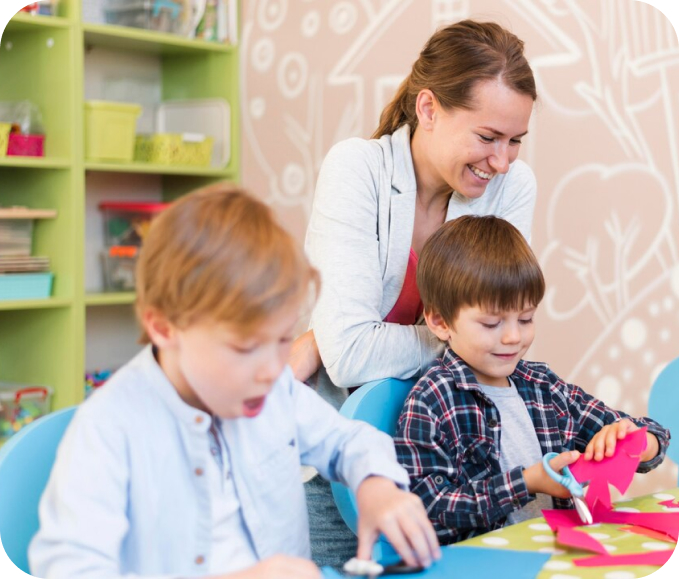
Contracts and payment
Contracts
At Kinderopvang Prins Vleermuis Campus, you will receive a contract for 52 weeks per year minus a three-week discount. In most cases, you will have a 49-week contract with us.
If you take one day a week, you are taking an average of 11 hours per week times 49 weeks is 539 hours per year. You divide this by 12 months, which means that you are only submitting a fixed number of hours of 44.92 per month annually to the IRS. So when there are closing weeks in a month, you also pay the same number of hours unless you purchase additional care. This keeps it easy.
If you start or stop earlier in a year, you may have to inform the Tax Administration of a change in the number of hours in your contract. You will then see this on the amended contract.
Payment
We always pay in advance and by direct debit. We make no exceptions to this. Please apply for childcare allowance at the tax office in time.
On your contract you can see what you need to provide. The direct debit usually takes place on or around the 26th of the previous month. The parent who registers as the first parent submits the direct debit authorization to us, but both parents/caregivers remain responsible for payment.
Unfortunately, in the past it sometimes happened that parents did not pay and used the
childcare allowance for other purposes. We therefore reserve the right to report tax fraud. Do you have financial questions or concerns? Please contact our location manager.

Alle vragen op een rijtje
Persoonlijk contact en communicatie vinden wij erg belangrijk. Dagelijks vindt er een overdracht plaats tussen u als ouder en onze pedagogisch medewerker. Zo vragen wij ‘s ochtends hoe het gaat en laat u in de ochtend weten of er bijzonderheden zijn die wij moeten weten. Ook bij het ophalen van uw kind vertellen wij u hoe het is gegaan en of er bijzonderheden zijn. Via onze Kids Konnect OuderApp hebben we daarnaast ook waardevol contact met ouders. Met deze app blijven ouders op de hoogte van de ontwikkelingen van hun kind(eren) wanneer zij op de kinderopvang zijn. Ouders kunnen de app downloaden op hun smartphone. In de baby leeftijd ontvangt u daarin een dagverslag met slaap- en flestijden, bijzonderheden en foto’s. In de dreumes leeftijd ontvangt u in de app een dagverslag met slaaptijden, foto’s en een verslagje van de dag. In de peuter leeftijd worden er veelal groepsactiviteiten gedeeld en foto’s van uw kind of van de groep kinderen. Via de app kunt u contact met ons opnemen, extra opvang aanvragen en afwezigheid melden. Ook zijn hier de nieuwsbrieven in te lezen en beleidsstukken van onze organisatie.
Daarnaast is er natuurlijk ook de administratieve communicatie. Onze managers voeren het eerste contact met u telefonisch of per e-mail. De financiële administratie stuurt de factuur per email welke doorgaans automatisch geïncasseerd wordt. Na aanvang van de opvang heeft u vooral contact met de mentor van uw kind en de pedagogisch medewerkers. Voel u altijd vrij om te bellen of mailen met kantoor als u vragen heeft die de pedagogisch medewerker niet kan beantwoorden.
Door uw kind in te schrijven gaat u akkoord met onze algemene voorwaarden. Een inschrijving kost €50,00 per kind. Hierbij ontvangt u een plek bij ons kinderdagverblijf, een intake en een wenafspraak. Wanneer u het inschrijfgeld heeft betaald is uw inschrijving definitief. Wanneer u toch besluit geen opvang bij ons af te nemen, vindt geen restitutie plaats.
Ons uurtarief voor reguliere opvang is €10,80 (in 2025). Het uurtarief voor flexibele (vakantie) opvang is €11,71. U kunt enkel hele dagen kinderopvang afnemen (7.30-18.30), u betaalt dus 11 uur per dag. Bij ons betaalt u elke maand hetzelfde bedrag, omdat wij het totale jaarbedrag gelijkmatig verdelen over twaalf maanden.
Het VVE uurtarief is €10,71. U kunt enkel halve dagen VVE afnemen (7.30-13.00 of 13.00-18.30). Uw kind komt twee dagdelen vanaf 2 jaar en wij berekenen dan 10 uur per week. Uw kind komt drie dagdelen vanaf 2,5 jaar en wij berekenen dan 16 uur per week.
De Belastingdienst vergoedt tot €10,71 per uur, afhankelijk van uw situatie en inkomen. Op www.toeslagen.nl kunt u een proefberekening voor uw toeslagen maken.
Het uurtarief wordt jaarlijks geïndexeerd door de kinderopvang. De indexatie hangt af van verschillende factoren en wordt vooraf besproken met de oudercommissie, alvorens door te voeren. Wij communiceren het nieuwe uurtarief altijd minimaal een maand van tevoren naar alle ouders. Mocht u zich dus eind van het jaar pas ingeschreven hebben bij ons, vraag dan altijd even naar het nieuwe tarief.
Ons kinderdagverblijf is op werkdagen te bereiken tussen 7.30 en 18.30 uur op ons vaste nummer 0317 358 119. Indien u ons telefonisch niet kunt bereiken kunt u een bericht sturen naar de Konnect OuderApp of mailen naar campus@kinderopvangprinsvleermuis.nl
In het geval dat u de locatie niet kunt bereiken en er is sprake van een acute noodsituatie, dan kunt u bellen naar 06 287 166 98.
Ons LRK nummer is 202286794
Register for Kinderopvang Prins Vleermuis
Register for Kinderopvang Prins Vleermuis
Easily enroll your child using the enrollment form below.
What does a day at the nursery look like?
What does a day at the nursery look like?
What does a day at the nursery look like? The daily routine below is based on the rhythm of the toddler group and toddler groups. In the baby groups, each baby has his or her own rhythm and we follow the rhythm of home.
7.30 – 9.30
From 7.30 our pedagogical professionals are ready to welcome the children and their parent(s). All children are greeted by name. A chat is held with the parents about how the child is doing. Did the child sleep and eat well? Are there any peculiarities? We say goodbye to the parent(s) together and then go play in the group where there are already toys or an activity ready.
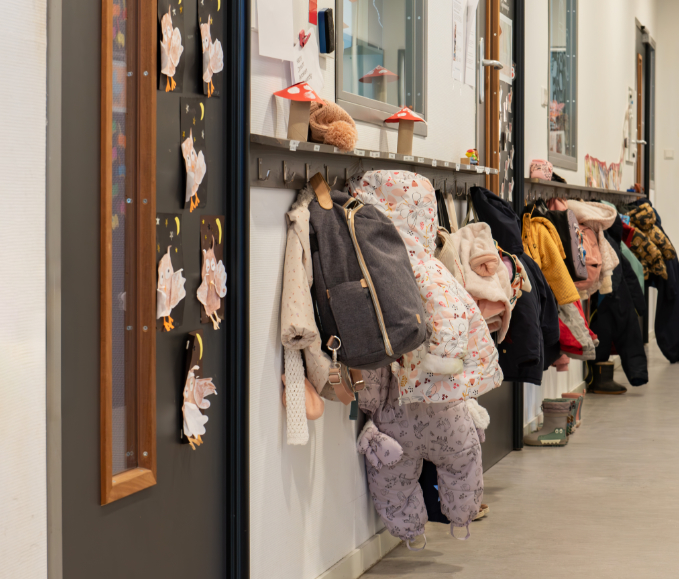
9.30 – 10.15
At 9.30 we start the day together in the circle. We sing songs and welcome everyone. Then we eat fruit together and drink a glass of water. We also often read a book and look at the daily routine cards with the children. This way the children know what a day will look like. After the fruit moment, the children go to the toilet or get a clean diaper. The children who are still sleeping go to bed now.
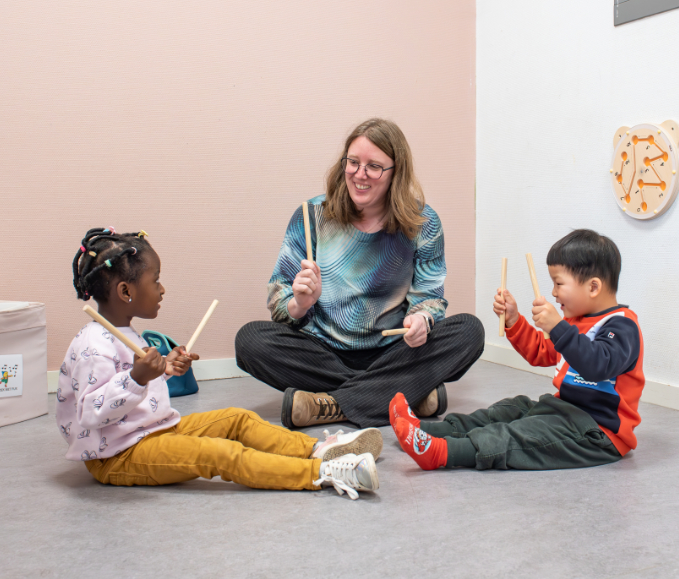
10.15 – 11.30
During this time we try to go outside with the children as much as possible. We ask parents to dress appropriately for the weather so that we can play outside in almost any weather. Sometimes a group of children stay inside to do an activity, they then go outside later.
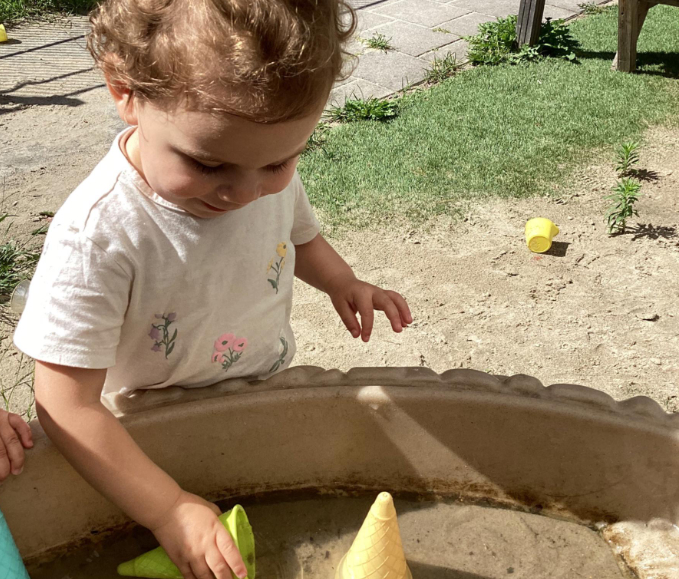
11.30 – 13.00
At 11.30 we sit down with the children to eat a sandwich. They are then given a glass of milk or water with it. The children learn from the toddler group to spread their own bread. We also sing a song at lunch. After eating, the children get a washcloth to clean their face and then the children go to the toilet or get a clean diaper. Some of the children now go to sleep.
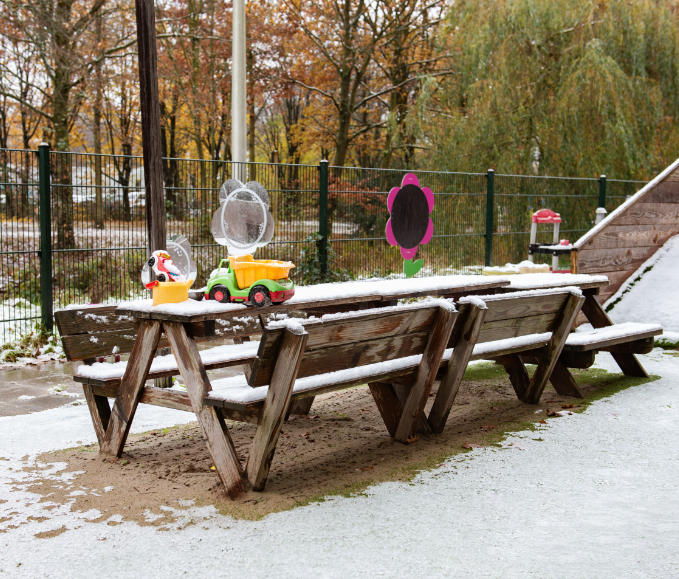
13.00 – 15.30
During this time most of the children are asleep and the pedagogical professionals take turns to take a break. The children who are awake do a quiet activity. They read a book in one of our cozy reading nooks or color at the table. The children who wake up are quietly changed until everyone is ready to go to the table around 3:30 pm.
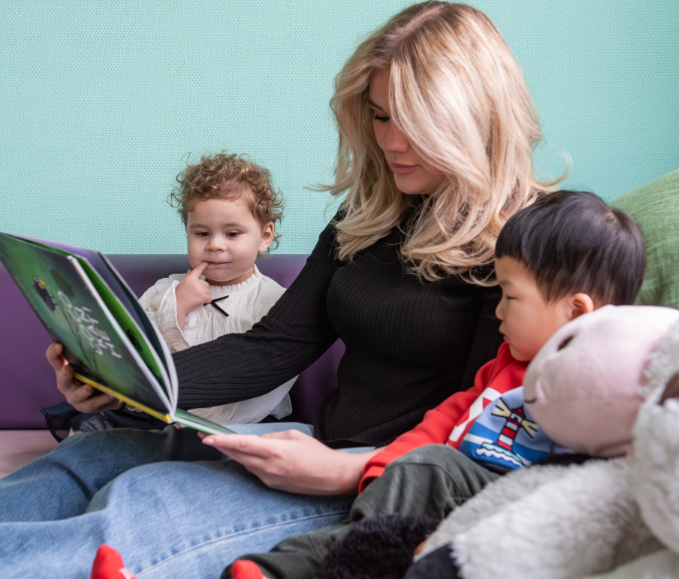
15.30 – 16.30
After all children are awake there is another table time when vegetables are eaten and a cracker. Sometimes we also steam vegetables such as broccoli and carrot. Again the children receive a glass of water.
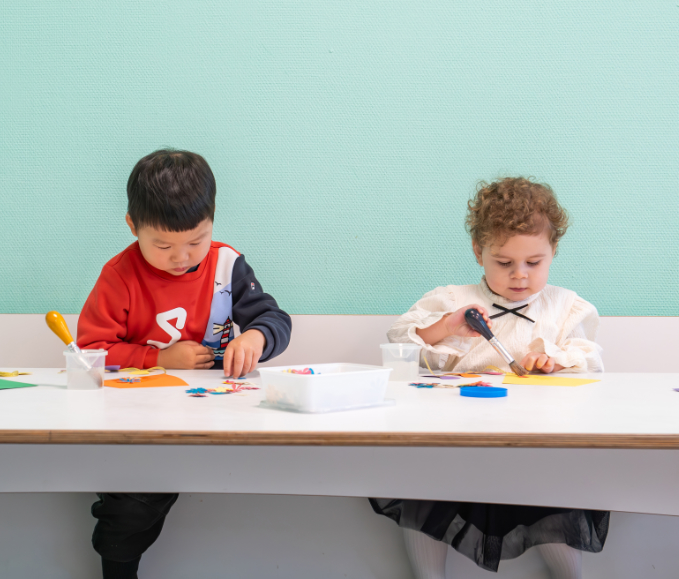
16.30 – 18.30
After the last meal there is time for free play. Often we also play outside. From 16.30 the first children are picked up. We discuss the day with the parents and say goodbye to the children. We are open until 6:30 pm.
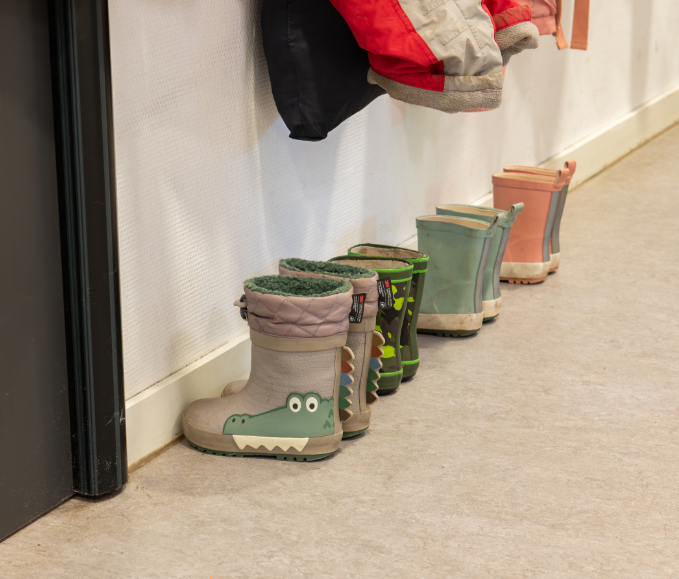
Thomas Gordon Method
Thomas Gordon Method
Kinderopvang Prins Vleermuis works with the Gordon Method. The Gordon Method is a way of communicating with children and with each other. Thomas Gordon was an American psychologist who saw similarities among his clients such as a power relationship between leader and subordinate and the relationship between a parent and a child. A child and a parent need not have a power relationship between them. Parents can consult with a child, give the child a voice and empathize with a child. Terms such as the “I or me message,” “active listening” and a “win-win situation” occur with us every day and our leaders can tell you all about it. Thomas Gordon has designed trainings and written books for parents and among other educational professionals. ‘The Gordon Method is an internationally protected method of working that is primarily concerned with promoting fun and balance in relationships and preventing and resolving conflict without losers. This way of relating to others leads to greater independence, self-confidence and growth in both educator and child (Gabeler, 2009)
The educational professionals at Kinderopvang Prins Vleermuis speak with the “I message” to indicate what is going on in them and so that they are clear to others. As children reach the age when they start talking, children will also learn to communicate from the “I message”. By telling what they feel, mean and think, this also encourages other children to put their feelings and thoughts into words. All this is done at eye level with the child, so that no power relationship is created that way either.
By actively listening, the Pedagogical Professionals try to promote the child’s feelings and perceptions (this can be done, for example, by listening, summarizing and asking through) through which a child will notice that the Pedagogical Professional is trying to understand and help the child and is taking them seriously. When children have a conflict we observe the children in resolving the conflict. When necessary, the Pedagogical Professionals will help by asking the children questions about the cause of the conflict, naming feelings of both children and asking questions about a possible solution. When the children reach a solution together, you have a win-win situation and the children can then get through the same door together again. Our Pedagogical professionals receive regular training and constant coaching. Interns are also welcome to attend courses and they are also constantly coached to use the Gordon Method. Therefore, you can expect the staff at Prins Vleermuis to communicate with you, your child and each other in a respectful manner and according to the Gordon Method.
Working At
About us
Kinderopvang Prins Vleermuis Campus has a young and dynamic team employing people from Wageningen but also from the surrounding area! Our team culture values are: happy, involved, sincere and equal. How do you see this reflected?
- We are honest and greet each other with a smile.
- We think with each other and share tasks.
- We show interest in each other and listen to each other.
- Moreover, we treat others as we would like to be treated ourselves!
Do you recognize yourself in our team culture values and would you like to work in a special place in Wageningen? Then click on the button below to send an open application.
Vacancies

Pedagogische toppers gezocht!
Ben jij een bevlogen pedagogisch medewerker met een groot hart voor kinderen? Werk jij graag in een dynamische, multiculturele omgeving én in een hecht team waar warmte, plezier en samenwerking centraal staan? Dan maken wij graag kennis met jou! Bij Kinderopvang Campus Wageningen werken we met een vlot en betrokken team dat écht oog heeft […]
Lees meer +Privacy Policy
Kinderopvang Prins Vleermuis handles privacy data with care and follows the General Data Protection Regulation (AVG). This is the European regulation that applies to all member states of the European Union. Effective May 25, 2018, the AVG succeeds the Personal Data Protection Act. The AVG imposes requirements on the use and processing of personal data (information traceable to natural persons).
In this privacy statement, the term “parent” is used. This refers to the parent or caretaker of the child who has parental authority over the child and who has signed the contract with Kinderopvang Prins Vleermuis. Hereby, Prins Vleermuis assumes that this parent will coordinate any requests arising from this privacy statement with the other parent (who is not a contract parent). If the parent or caregiver who does not have a contract with Prins Vleermuis also wishes to exercise the rights, he/she may do so in coordination with the contract parent.
Contact information:
Website: https://wageningenkinderopvang.nl/
Address location Kazerne: Verbindelaarsweg 140, 6711 VD, Ede
Phone number location Kazerne: 0318 300 877
Address location Kernhem: Stakenberg 85, 6718 DG, Ede
Location phone number Kernhem: 0318 229 804
Address location Campus: Plantage 10, 6708 WJ, Wageningen
Phone number location Campus: 0317 358 119
Nikki van Beers is the Data Protection Officer of Kinderopvang Prins Vleermuis. She can be reached at beleid@kinderopvangprinsvleermuis.nl. Personal data that we process Kinderopvang Prins Vleermuis processes your personal data because you use our services. Below is an overview of the personal data we process. We distinguish between data requested at registration and data requested at intake and start of care.
At registration:
Name, address, place of residence;
Gender, date of birth, marital status, nationality and BSN;
Phone number(s) and e-mail address(es);
Emergency contact information;
Bank and financial information;
Relevant developmental data of the child;
Type of care;
Dayparts on which care takes place or is desired;
Elementary school the child attends or intends to attend.
During intake and start of care
Child information (including details of family doctor, dentist, health insurance);
Permission for photo and film material;
Privacy statement Prins Vleermuis
Observation data;
Declaration of medication administration when applicable;
Relevant health data, such as vaccinations, allergies and nutrition.
Report intake.
The (registration) data will not be kept longer than necessary. The retention period for a data is determined on the one hand by legal (fiscal) retention periods and on the other hand by recommended retention periods.
Minors
Our website and/or service does not intend to collect data on website visitors who are under the age of 16, unless they have parental or guardian consent. However, we cannot verify that a visitor is 16 years of age or older. Therefore, we encourage parents to be involved in their children’s online activities in order to avoid collecting information about children without parental consent. If you believe that we have collected personal information about a minor without such consent, please contact us at beleid@kinderopvangprinsvleermuis.nl and we will delete this information.
For what purpose and on what basis do we process personal data Childcare Prins Vleermuis processes your personal data for the following purposes:
– Agreeing the contract.
– Handling your payment
– Sending our newsletter
– Calling or emailing you if necessary to carry out our services
– Informing you about changes in our services and products
– Offering you the possibility to create an account
– Keeping data that are important for the care, support and development of the child.
development of the child
– Maintaining contact with parents, guardians and caregivers of children
– Kinderopvang Prins Vleermuis also processes personal data if we are legally obliged to do so such as data we need for our tax return or for your right to childcare benefit childcare allowance.
Where is the data stored?
The personal data of parents and children are kept digitally or stored in filing cabinets. The filing cabinets are located in the office. In the absence of a member of the management team, the office is locked.
All electronics such as computers, laptops and telephones are provided with a password and/or login code and are known only to those employees who are authorized to do so.
How long we store personal data
Kinderopvang Prins Vleermuis will not retain your personal data longer than is strictly necessary to achieve the purposes for which your data is collected. We use the following retention periods for the following (categories) of personal data in accordance with the AVG. For tax data, the statutory period of 7 to 10 years is used. For other data a maximum period of 2 years after termination of an agreement applies.
Sharing personal data with third parties
Kinderopvang Prins Vleermuis will only share personal data with third parties if necessary for the execution of our agreement with you or to comply with a legal obligation.
Cookies, or similar techniques, that we use
Kinderopvang Prins Vleermuis uses functional, analytical and tracking cookies. A cookie is a small text file that is stored in the browser of your computer, tablet or smartphone the first time you visit this website. Kinderopvang Prins Vleermuis uses cookies with a purely technical functionality. These ensure that the website works properly and that, for example, your preferences are remembered. These cookies are also used to make the website work properly and to optimize it. In addition, we place cookies that track your browsing behaviour so that we can offer tailored content and advertisements.
During your first visit to our website, we have already informed you about these cookies and asked your permission to place them. You can opt out of cookies by setting your Internet browser to no longer store cookies. In addition, you can also delete any information previously stored through your browser settings. For an explanation, see:
https://veiliginternetten.nl/themes/situatie/cookies-wat-zijn-het-en-wat-doe-ik-ermee/
Accessing, modifying or deleting data
You have the right to view, correct or delete your personal data. You can do this yourself via the personal settings of your account. In addition, you have the right to withdraw your possible consent to data processing or object to the processing of your personal data by our company and you have the right to data portability. This means that you can submit a request to us to send the personal data that we hold about you in a computer file to you or another organization named by you. If you wish to exercise your right of objection and/or right to data portability, or if you have other questions/comments about data processing, please send an itemized request to beleid@kinderopvangprinsvleermuis.nl.
To make sure that the request for inspection is made by you, we ask you to send a copy of your ID with the request. In this copy, please include your passport photo, MRZ (machine readable zone, the strip of numbers at the bottom of the passport), passport number and
Burgerservicenummer (BSN) in black. This is to protect your privacy. Kinderopvang Prins
Vleermuis will respond to your request as quickly as possible, but in any case within four weeks.
Kinderopvang Prins Vleermuis would also like to point out that you have the possibility to file a complaint with the national supervisory authority, the Authority for Personal Data. This can be done via the following link: https://autoriteitpersoonsgegevens.nl/nl/contact-met-de-autoriteit-persoonsgegevens/tip-ons
How we secure personal data
Kinderopvang Prins Vleermuis takes the protection of your data seriously and takes appropriate
measures to prevent abuse, loss, unauthorized access, unwanted disclosure and unauthorized modification. If you have the impression that your data is not properly secured or there are indications of abuse, please contact us at beleid@kinderopvangprinsvleermuis.nl.
The data is stored on servers secured by us, or those of a third party
with which we have entered into a processing agreement.
All electronics such as computers, laptops and telephones are provided with a password and/or login code and are known only to those employees who are authorized to do so.
If there are differences between the Dutch version of this policy and the English version of this policy, the Dutch version will always prevail.
Location
Openingstijden
| Monday | 7.30am-6.30pm |
| Tuesday | 7.30am-6.30pm |
| Wednesday | 7.30am-6.30pm |
| Thursday | 7.30am-6.30pm |
| Friday | 30am-6.30pm |
| Saturday | Closed |
| Sunday | Closed |
You can bring your child between 7.30 and 9.20 so we can have circle time at 9.30. At the end of the day you can pick up your child between 16.30 and 18.20 so that we have time for a personal handover.
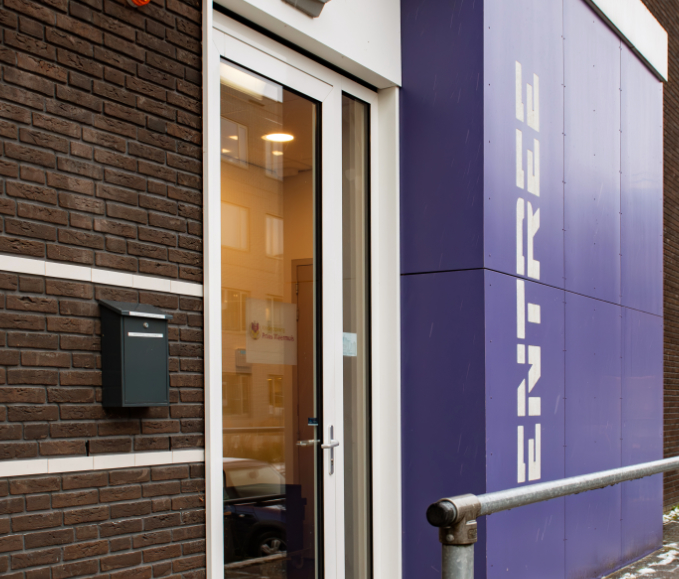
Location Information
Our childcare facility is located on the grounds of Wageningen University (WUR), opposite Zwembad de Bongerd. Our location consists of 5 groups. On both sides of the location we have a garden. One garden, which includes a sandbox and play hill, is designed for children aged 0-2 years. The other garden, which includes a large sandbox and trampoline, is set up for children aged 2-4.
Group assignment:
0-2: Babymuisjes
0-2: Dwergmuisjes
1-3: Supermuisjes
2-4: Kaboutermuisjes (VVE groep)
2-4: Reuzenmuisjes
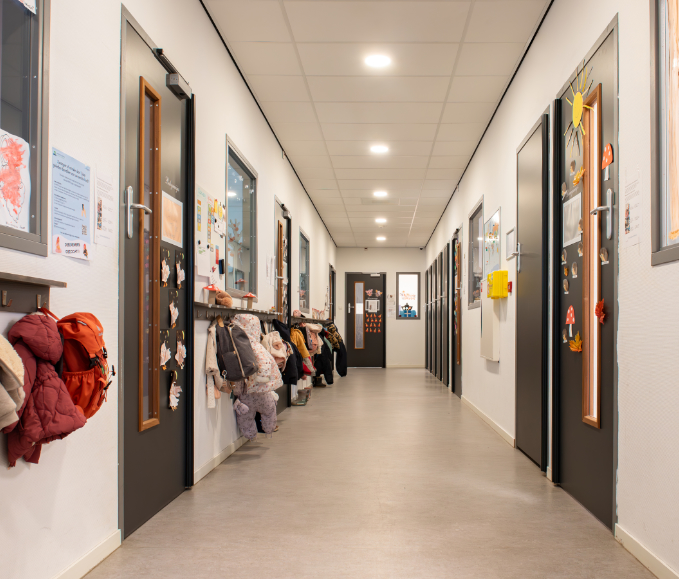
Accessibility
Kinderopvang Prins Vleermuis Wageningen Campus can be reached within 5 to 10 minutes from Wageningen and Bennekom. We are located on the WUR Campus grounds and opposite sports center De Bongerd.
From North-West you can reach us in less than 5 minutes by bike along the bus lane (Akkermaalsbos). The Tarthorst is even within walking distance.
Traveling by car?
Then you can park within walking distance around the Bongerd/ WUR Campus area or you can enter the WUR Campus via Mansholtlaan and park in front of our door. Very convenient with Maxi-Cosi!
From Bennekom you cross the Mansholtlaan or you can easily bypass the traffic by bike. We have many customers from Wageningen, Bennekom and Ede, but also from other parts of the country.
For residents from Bennekom and Ede and beyond, there is a route through the inner field (Bornsesteeg) for rush hour traffic. We are 10 minutes away from the A12 and 2 minutes away from Mansholtlaan (car).
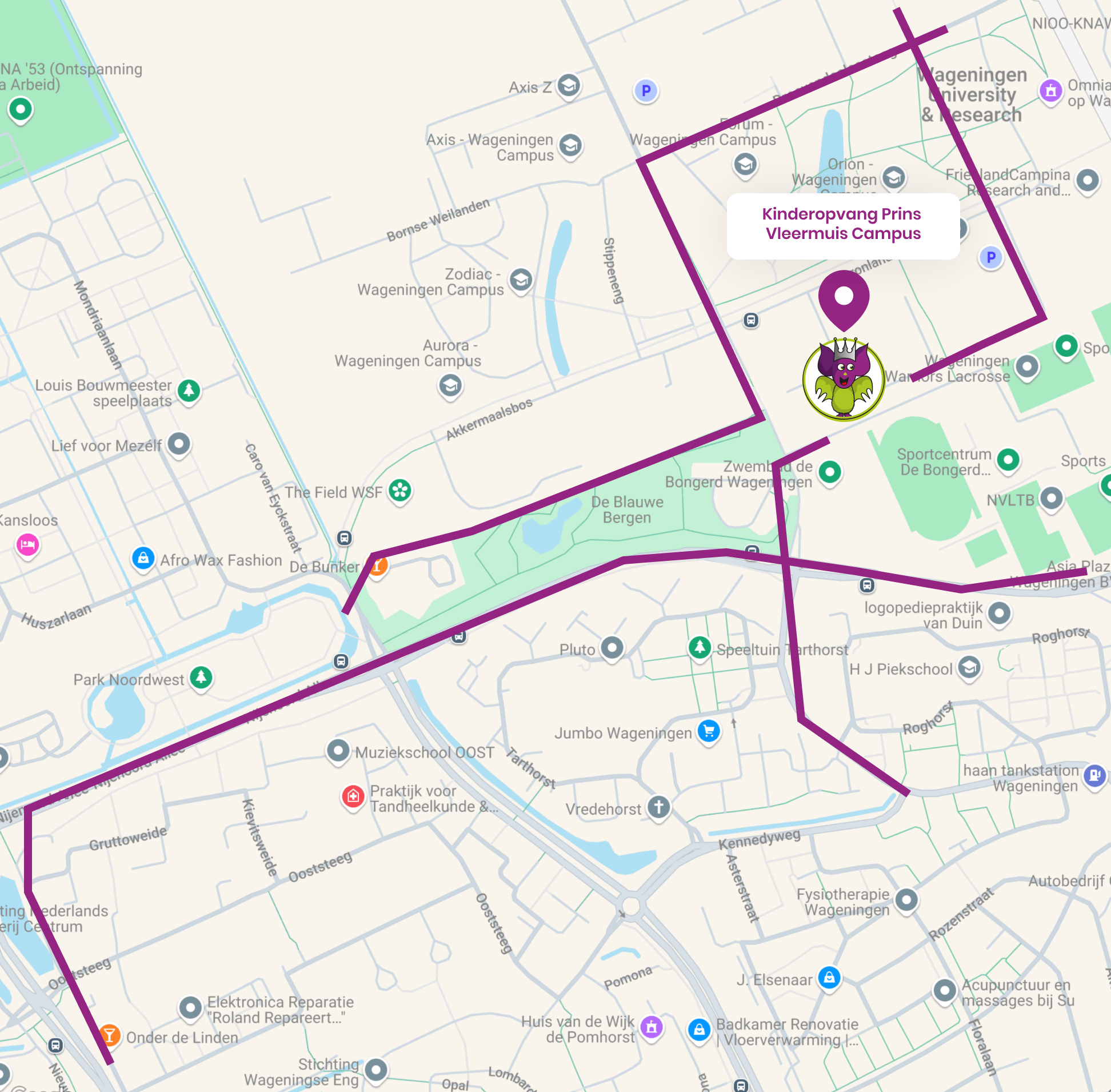
VVE
VVE
Children who need more can sometimes get a referral for Early Childhood Education (VVE). With VVE, children receive additional support in child care. A referral is needed for VVE. This referral can be obtained through the child health care office (from the age of two).
At Kinderopvang Prins Vleermuis Campus, we also offer a VVE program. By offering preschool education, the goal is to better prepare these children for elementary school and ensure that they can happily attend elementary school with less, or even no, delay.
VVE in practice
Every child has a mentor. The mentor of children with a VVE referral will offer appropriate extra activities based on the developmental objectives. Because toddlers with a VVE referral attend several half-day sessions, they receive a lot of repetition and we can monitor the children better together with the parents. We look at what a toddler needs and focus on that. Only pedagogical professionals with VE certification work in the VE group.
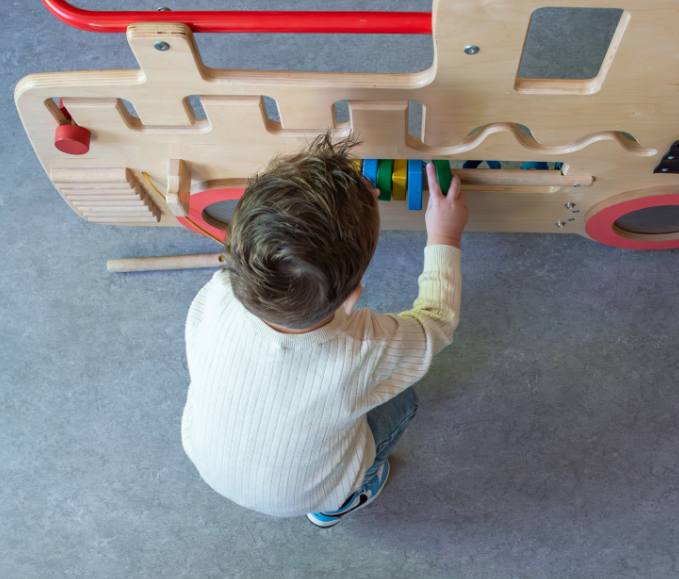
Own VVE program
We use our own VVE program that we develop ourselves. This also involves the pedagogical professionals. The themes are tailored to the children’s experiences, such as a theme about spring. We go outside to discover what is growing and blossoming around the nursery and grow our own vegetables!
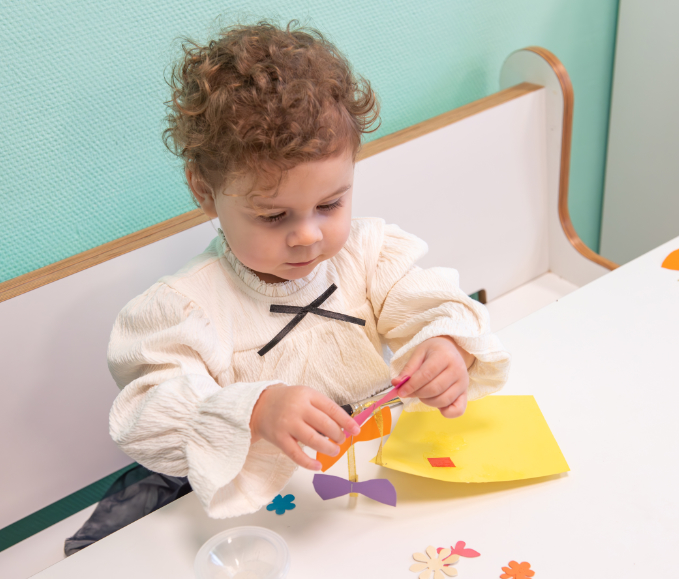
School vacations
Childcare
Childcare
Since April 2017, the location childcare Prins Vleermuis Campus has been located in Wageningen. Kinderopvang Prins Vleermuis Campus provides care for children aged 0 to 4 years. We have two baby groups, one toddler group and two pre-schooler groups.
Baby groups
In our baby groups we follow the child’s own rhythm as much as possible. When the children grow older and move to the toddler group and pre-schooler group, there is a fixed and familiar daily rhythm. The days are predictable and this provides peace and space for further development.
We find it important to provide a stimulating environment where children feel safe and can develop optimally. We therefore work with themes that connect to the children’s experiences with activities that match the children’s developmental level.
Our pedagogical professionals themselves are the creative pivot in devising and carrying out the activities which means that they are always involved in the children’s development and that our themes fit seamlessly with the developmental needs of the child.
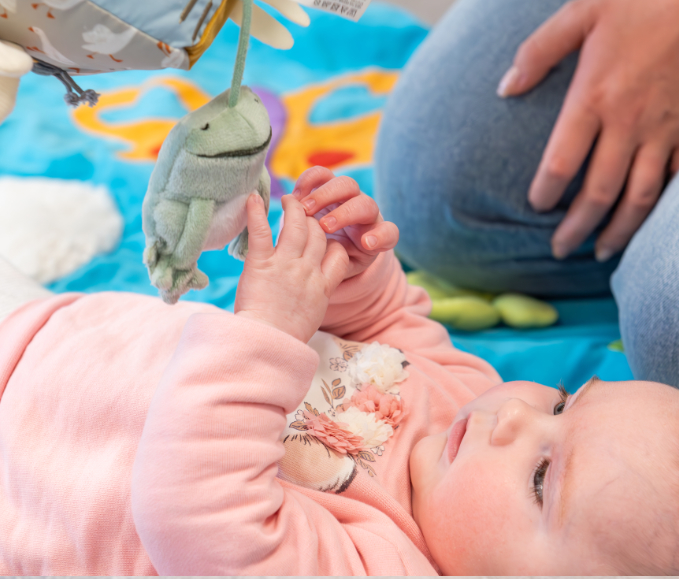
Learning through play!
Through play, children learn about the world around them. Play is not only fun but also stimulates all areas of development. We follow the children in their play and enrich it with activities that match the children’s experience.
The Thomas Gordon method
Communication is very important to us. We therefore work with Thomas Gordon’s Gordon method. By actively listening, the pedagogical professionals try to put the child’s feelings and experiences into words, through which a child will notice that the pedagogical employee tries to understand the child and takes him or her seriously.
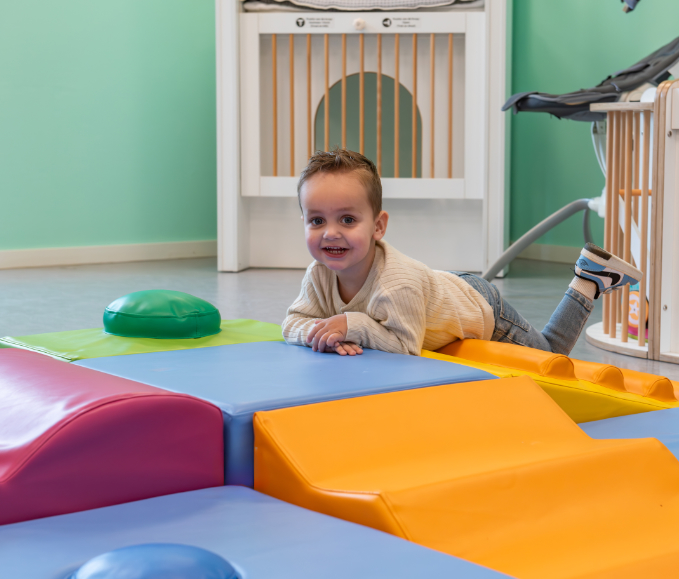
Society in miniature
Because our daycare is located in the middle of the Campus grounds, children from all over the world play with us. Our daycare is therefore a society in miniature where we learn about multiple cultures and customs. Of course, children from all over Wageningen are welcome to join us!
The mission and vision of Prins Vleermuis
Our mission is that children will eventually develop themselves into social, independent people with self-confidence and a sense of responsibility. So that children can grow into people who know and can use their own talents.
To achieve this, we give every space for the individuality of each child. We create a homely environment in which children feel safe and secure. The approach is focused on building on what a child can already do and what the child likes. We always choose a positive approach to the child, so that the child’s self-confidence can grow.
From an early age, the young child likes to be surrounded by other children. By interacting with other children, they learn to develop themselves and develop their own “I”. In addition, it is nice for parents to spar with our pedagogical professionals and, if desired, with each other. Social contacts grow and together we enlarge the world of the happy child.
Nutrition
Learning healthy habits is easier than unlearning something unhealthy later. This is why we play a major role in food education from an early age. Our nursery offers responsible and healthy food and sets an example for parents. Our nutrition policy has been developed in collaboration with the parent committee.
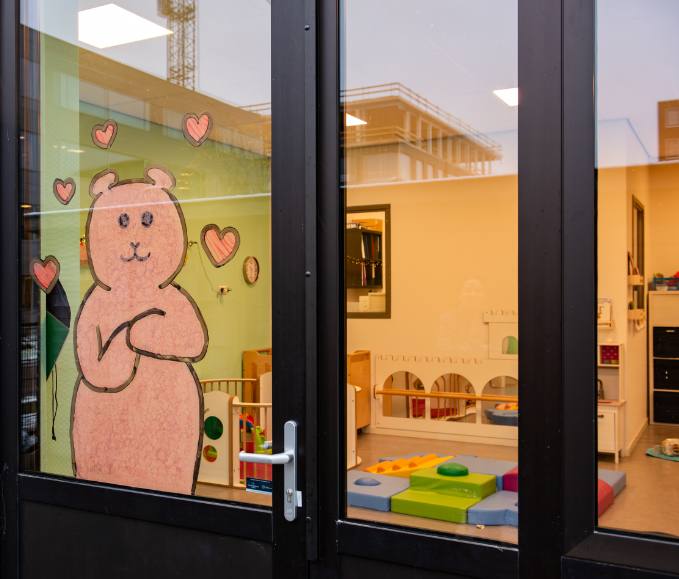
Sleeping
Most children at the nursery are still sleeping for a (large) part of the day. Therefore, it is important that the children have a safe and familiar sleeping environment where they can relax. Our baby groups both have their own bedroom. We also have a crib in sight on the groups for the little ones. The toddler group also has two private bedrooms. From the pre-schooler group onwards, the children sleep on a stretcher in the group.
Wageningen Campus Childcare
Confidence and affection in caring for your little ones.
Support and care at every stage of your little one’s life

Regular staff, familiar face.
Every day a team of permanent staff is present to care for your child. This makes children quickly feel at home and we are a safe haven for both parent and child. You and your child(ren) can always rely on our staff.

Healthy childcare
In our eyes, every child deserves a healthy start. Healthy childcare is not only about nutrition but also about sufficient exercise, good sleep and a regular daily rhythm. We are always evolving when it comes to healthy child care!

Every child deserves a crown
All children at Prins Vleermuis are allowed to be who they are and are welcomed in love. Prins Vleermuis offers warmth, support and joy, also for parents. At our daycare, we take each child’s feelings, ideas and dreams seriously.
Discover the benefits of child care
Social development in a home-like setting
Children’s social development is a dynamic process that lays a solid foundation for their future. This process begins at birth. The nursery provides a rich and supportive environment in which children can practice and develop essential social skills. It is a home-based mini-society where they learn not only how to interact with others, but also how to express themselves as individuals within a group. Thus, the nursery plays an indispensable role in a child’s overall development. Children who have experienced positive social interactions at an early age often develop stronger social skills and self-confidence. They are better prepared to build relationships, both in their personal lives and in their future professional environments.
Comments that reflect our commitment
Read what other parents are saying about our care.
Our daughter has been going to Prins Vleermuis Campus for a year and a half now and we are very happy with the experience. The teachers are attentive, organize nice activities and “day trips” for the kids and are always open to answering our questions as parents.
There hasn’t really been a problem with transitioning from one group to another and our daughter is always happy to go to daycare. Especially after vacation periods she literally runs in, ready to meet everyone with excitement!
As an expact family we are also really happy that we can rely on a team of professionals who have experience with kids from different backgrounds and the intricacies of raising multilingual/ multicultural kids. We definitely feel like out daughter’s needs are well met and we can see that she learns a lot socially and communication wise.
All in all, definitely recommend!
Nikol Popova Dokov

Ryan v M (ryvamo)

Zeer fijne kinderopvang, zeer fijne leerkrachten en goede ligging. Aanrader!
Karolina Drobnytė

Fijne kinderopvang met attente en zorgzame docenten. Ze besteden echt tijd aan het leren van de kinderen over verschillende onderwerpen en laten ze verschillende activiteiten verkennen. Mijn dochter rent letterlijk naar binnen, zeker na een vakantie 😁
Nikol Popova Dokov

Fijne kinderopvang op een goede locatie op de wageningen campus. Fijn personeel met een hart voor de kinderen. Onze dochter gaat er met plezier heen!
Ellen Alex

Kinderopvang Prins Vleermuis in Wageningen en wel op de Campus is een zeer prettige verblijf voor kinderen. Ik raad deze zeker aan. Aardig personeel, leuke locatie en lekker dicht bij je werk als je op de campus werkt
Edwin de Schipper
5 minutes away from almost all parts of Wageningen
Centrally located daycare, easy to reach from all over Wageningen!
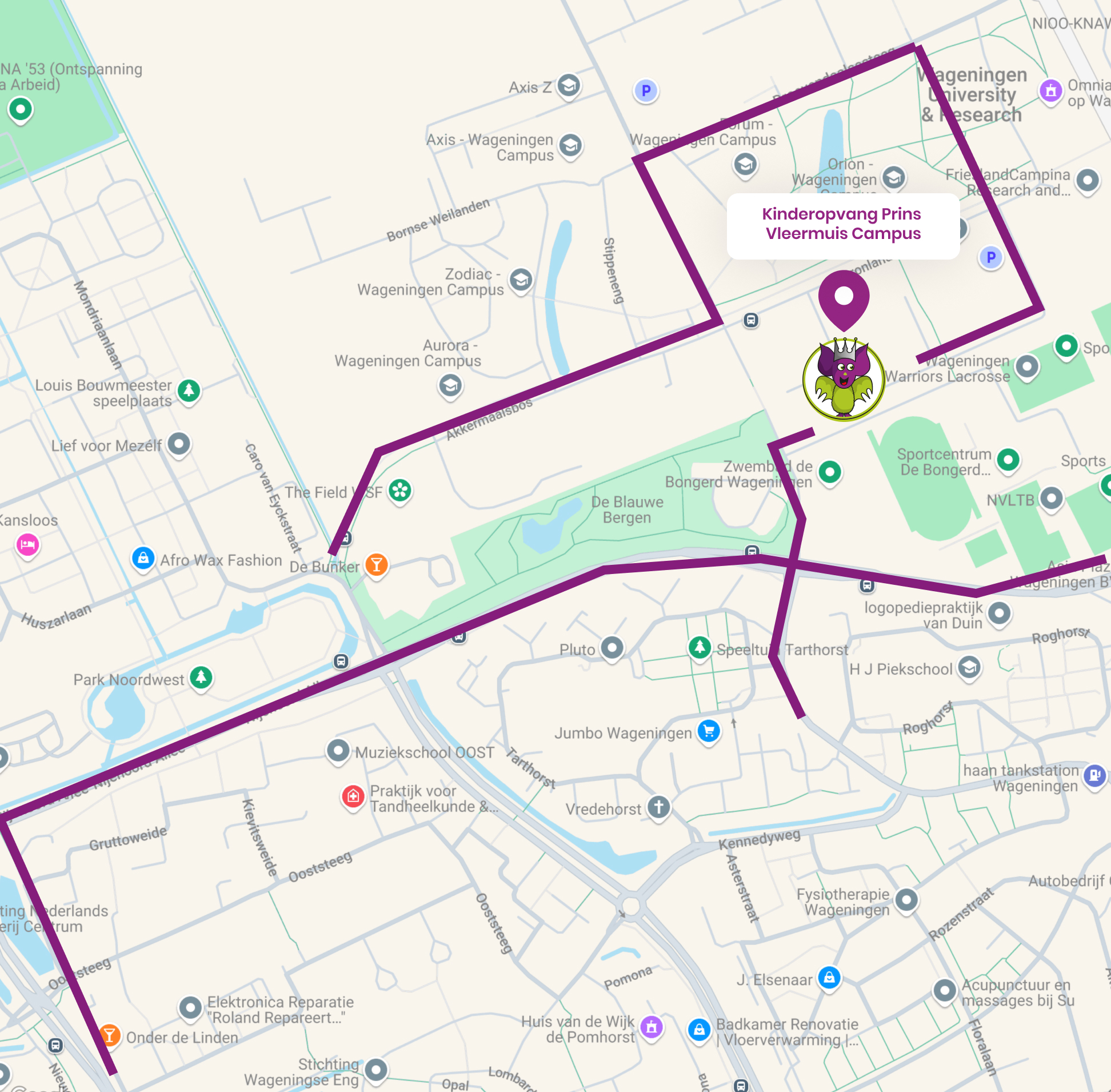
Pedagogical policy
Contact us
6708 WJ Wageningen
Our nursery can be reached on weekdays between 7:30 a.m. and 6:30 p.m. on our landline number +31 317 358 119. If you cannot reach us by phone you can send a message to the Konnect ParentApp or email us at campus@kinderopvangprinsvleermuis.nl.
In case you cannot reach the location and there is an acute emergency, please call +31 6 287 166 98.
Our LRK number is 202286794

Wageningen University promised access road on west side of Wageningen in near future.
Good news for everyone who wants to reach Wageningen University by car. Construction will soon begin on a new access road to the west side of the Wageningen campus. It will be located along the bus lane, where a bike path currently runs. This road will be completed within six months. Ideal if you want […]
Lees meer